Mallet vs Blade Putter: How to Choose the Right One
A blade putter is compact, lighter, and gives more feedback. A mallet putter is larger, heavier, and more forgiving on mishits. Blades suit arc strokes. Mallets suit straight strokes. But both share one limitation: a flat face with a single fixed loft. That is the variable most comparison guides never mention.
Blade Putters: What They Are and Who They're For
A blade putter has a thin, flat head with most of the weight concentrated near the center. The shape dates back to the origins of putting. The Ping Anser, introduced in 1966, defined the modern blade and remains the most copied putter design in the history of the sport.
Blade heads are narrow from front to back, typically 2.5 to 3.5 inches deep. Weight usually ranges from 340 to 360 grams. The compact profile sits tight to the ground and gives the golfer a clear view of the target line at address.
Key characteristics
- Weight distribution: Concentrated in the center of the head. Less perimeter weighting than mallets. That means less resistance to twisting on off-center hits, but more precise feedback on pure strikes.
- MOI (Moment of Inertia): Lower than mallets. Typical blade MOI sits between 3,000 and 5,000 g-cm². Lower MOI means the head is more responsive to stroke inputs, but less forgiving when you miss the center.
- Toe hang: Most blades have moderate to full toe hang, meaning the toe drops toward the ground when you balance the shaft on your finger. This natural rotation makes blades a match for arc putting strokes.
- Feel and feedback: Blades transmit impact vibration more directly to the hands. You know immediately whether you caught it clean. Players who value tactile feedback almost always prefer blades.
- Alignment: Minimal. A topline and maybe a single sight dot. Blade players typically aim using the leading edge and the overall shape rather than alignment aids.
Who blades are for
Golfers with an arc putting stroke. Players who want to feel the hit and use that feedback to calibrate their next putt. Low to mid-handicap players who value control over forgiveness. Tour pros still use blades at a significant rate, though mallet adoption has grown steadily since 2020.
If you prefer a compact look at address, want your hands involved in the stroke, and trust your ability to find the center of the face, a blade is a natural fit. Read our full guide on matching putters to arc strokes.
Mallet Putters: What They Are and Who They're For
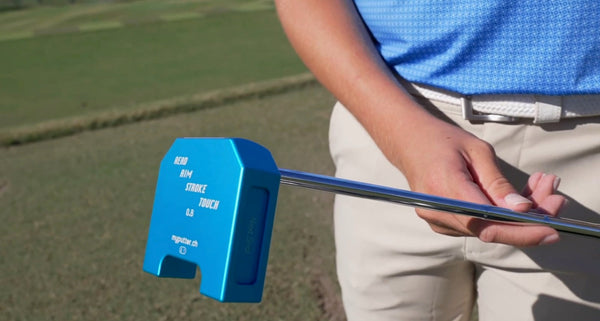
A mallet putter has a larger, deeper head. The extra real estate allows weight to be distributed around the perimeter, away from the center. That perimeter weighting is what gives mallets their defining trait: forgiveness.
Mallet heads range from 4 to 6 inches deep, sometimes more. Total head weight typically sits between 350 and 380 grams. Shapes vary widely. Semicircles, squares, fangs, half-moon designs. The TaylorMade Spider and Odyssey 2-Ball are among the most recognized mallet silhouettes on Tour.
Key characteristics
- Weight distribution: Pushed to the perimeter. Heel-toe weighting and rear weighting create stability through the stroke and at impact. Off-center hits lose less energy and stay closer to the intended line.
- MOI: Higher than blades. Many modern mallets exceed 5,000 g-cm², with some reaching 8,000 or more. Higher MOI means the head resists twisting. Mishits still go roughly where you aimed. MyGolfSpy testing in 2025 found that top-performing mallets outperformed blades by 7% at six-foot distances.
- Toe hang: Most mallets are face-balanced or close to it. The face points straight at the sky when you balance the shaft. This makes mallets a natural fit for straight-back, straight-through (SBST) strokes. Some mallets with slant necks or plumber's necks do have toe hang for slight arcs.
- Feel and feedback: Softer and more muted than blades. The larger head and perimeter weighting absorb vibration at impact. Some players describe the feel as "deadened." Others call it stable. It is a matter of preference.
- Alignment: Prominent. Lines, dots, contrasting colors, geometric shapes. The larger head surface makes room for alignment features that help the golfer aim the putter face consistently.
Who mallets are for
Golfers with a SBST or very slight arc stroke. Players who want maximum forgiveness on off-center strikes. Higher handicap players who benefit from visual alignment aids. Golfers who prioritize consistency over feel.
Among the top 50 PGA Tour players in strokes gained putting in 2025, roughly 41 used mallets compared to 9 using blades. The trend is clear. When the margin is one putt over 72 holes, Tour players are choosing forgiveness.
One variable that pairs directly with head shape: grip diameter. A smaller diameter allows more wrist rotation, which can fight the mallet's straight-stroke advantage. A thicker diameter quiets the wrists, which can fight the blade's natural arc sensitivity. Head shape and grip diameter interact more than most guides admit. Match them on purpose.
Looking to understand how all putter specs fit together? Start with our complete putter selection guide.
Blade vs Mallet: Head-to-Head Comparison
The table below compares every specification that matters when choosing between a blade and a mallet. Use it as a reference point, not a verdict. The right putter depends on your stroke, your preferences, and one more factor covered later in this guide.
| Spec | Blade Putter | Mallet Putter |
|---|---|---|
| Head shape | Thin, compact, traditional | Large, deep, varied shapes |
| Head weight | 340-360g typical | 350-380g typical |
| MOI | 3,000-5,000 g-cm² | 5,000-8,000+ g-cm² |
| Forgiveness (horizontal) | Lower. Off-center = energy loss | Higher. Perimeter weight resists twist |
| Toe hang | Moderate to full | Face-balanced to slight |
| Best stroke type | Arc (moderate to strong) | SBST or very slight arc |
| Feel | Direct, responsive, firm | Softer, muted, stable |
| Alignment aids | Minimal (topline, sight dot) | Prominent (lines, shapes, contrast) |
| Feedback on mishits | Very noticeable | Dampened |
| Distance control | Better feel-based control | More consistent on mishits |
| Face type | Flat (single fixed loft) | Flat (single fixed loft) |
Notice the last row. Blade or mallet, the face is flat. One fixed loft. That row stays the same regardless of which column you prefer. Hold that thought.
How to Match Your Putter to Your Stroke Type
Your putting stroke is the single most important variable when choosing between a blade and a mallet. Not brand. Not price. Not what your playing partner uses. Your stroke determines which head geometry helps you and which one fights you.
Identify your stroke
Set your phone on the ground behind you, aimed at the putter head. Hit five putts from 10 feet. Watch the replay.
- Arc stroke: The head moves inside the target line on the backswing, returns to square, then moves inside again on the follow-through. The face opens going back and closes going through. Over 70% of golfers show some degree of arc.
- SBST (straight-back, straight-through): The head stays on the target line throughout the stroke. Minimal face rotation. Less common than most golfers think.
Match the putter to the stroke
An arc stroke needs a putter with toe hang. The toe hang allows the head to open and close naturally with the stroke. Most blades and some mid-mallets have the right amount of toe hang for arc strokes.
A SBST stroke needs a face-balanced putter. Face-balanced putters resist rotation, which suits a stroke that does not rotate. Most full mallets are face-balanced.
Using the wrong match creates a fight between your hands and the putter. Your hands want to arc. The face-balanced mallet resists rotation. Something has to give. The same problem works in reverse: a SBST stroke with a high toe-hang blade means the putter wants to rotate and your stroke does not.
The toe hang test
Balance your putter shaft across your index finger near the hosel. Let it settle.
- Face points at the sky: face-balanced. Best for SBST strokes. Most full mallets.
- Toe drops slightly (20-45 degrees): moderate toe hang. Best for slight to moderate arcs. Mid-mallets and some blades.
- Toe drops significantly (45-90 degrees): full toe hang. Best for strong arcs. Blades with plumber's neck or heel shaft.
If the toe hang of your putter does not match your stroke type, you are compensating on every putt. Our arc stroke putter guide covers this in detail, with specific models for each arc category.
Mid-Mallet: The Best of Both Worlds?
A mid-mallet sits between the blade and the full mallet. The head is larger than a blade but more compact than a full mallet. Think of it as a blade that grew up but did not become a spaceship.
Mid-mallets typically have moderate MOI. Higher than a blade, lower than a full mallet. They often come with flow neck hosels that provide moderate toe hang. That makes them compatible with the most common stroke type: the slight arc.
Why mid-mallets are gaining ground
The golfer with a slight arc (the majority) faces a trade-off with traditional putters. Blades give the right toe hang but less forgiveness. Full mallets give forgiveness but wrong toe hang. Mid-mallets split the difference.
- More forgiveness than a blade on heel-toe mishits
- Moderate toe hang that matches a slight arc
- Compact enough at address to feel controlled
- Room for alignment aids without the bulky appearance
The Odyssey Ai-ONE Rossie, the TaylorMade Spider GT Rollback, and the PING DS 72 are examples of mid-mallets that have performed well in independent testing. Each offers a version of the same premise: forgiveness with enough toe hang for a slight arc.
Limitations
Mid-mallets are a compromise. They do not offer the pure feedback of a blade. They do not match the forgiveness ceiling of a full mallet. For golfers with a strong arc or a pure SBST stroke, a mid-mallet may not commit enough in either direction.
And like blades and full mallets, mid-mallets use a flat face with a single fixed loft.
The Dimension Every Comparison Guide Misses
Every mallet vs blade comparison covers the same ground. Head shape. Weight. MOI. Toe hang. Alignment. Stroke type. These are the horizontal axis variables. They determine how the putter moves from heel to toe, how it resists twisting, and whether it matches your stroke path.
None of them mention the face.
Not the insert material. Not the milling pattern. The face geometry itself. The vertical axis.
Every blade on the market has a flat face with a single fixed loft, usually 3 to 4 degrees. Every mallet on the market has the same flat face with the same single fixed loft. Every mid-mallet too. The entire putter industry designed thousands of head shapes and solved the horizontal axis six different ways. Not one of them changed the face. Here is what that fixed loft actually does to your distance.
Every comparison guide covers shape, weight, and alignment. None of them mention the face.
Here is why that matters. Your hands are never in the same position twice at impact. You press forward under pressure. You hang back on fast greens. On the first putt, your hands sit slightly ahead. On the 18th, they sit slightly behind. Every shift changes the effective loft that the ball sees at contact.
Press forward: the face de-lofts. The ball drives into the ground, bounces, skids. Distance unpredictable.
Hang back: the face adds loft. The ball pops up, stays airborne longer, lands differently. Distance unpredictable.
On a 20-foot putt, these small hand variations can produce 2 to 3 feet of distance spread. Not because you swung differently. Because the flat face amplified a few millimeters of hand movement into inches of distance error.
Blade or mallet, the problem is the same. You chose the right shape for your stroke. You matched the toe hang. You found your alignment. And your distance is still inconsistent because every flat face treats hand variation the same way: by passing it straight through to the ball.
The choice is not blade vs mallet. The choice is what kind of face sits on the putter you picked.
Not sure which putter shape fits your stroke?
Send us three video clips of your putting stroke. We analyze the arc, the tempo, and the hand position at impact. Free. No obligation.
Get Your Free Stroke AnalysisFlat Face vs Curved Face: The Real Choice
A curved face is convex. The loft varies continuously from the bottom of the face to the top. No single fixed angle. A gradient instead.
When your hands press forward, you strike the ball higher on the face where there is more loft. The extra loft compensates for the de-lofting your hands created. When your hands hang back, you strike lower where there is less loft. The reduced loft compensates for the extra loft your hand position added.
The launch angle stays consistent. The ball speed stays consistent. The distance stays consistent.
Three things happen simultaneously with a curved face:
- Loft adapts to hand position. Your hands shift. The face compensates. The launch stays the same regardless of where your hands sit at impact.
- The ball contacts above the equator. The curved geometry ensures contact just above the ball's center line. That produces immediate forward spin. Skid is reduced. The ball gets into true roll faster and holds its line better.
- The vertical sweet spot expands. A flat face has a 1-2mm vertical sweet spot. A curved face extends that to approximately 6mm. The impact factor stays constant at 1.60 to 1.62 across the entire ellipse. Same energy transfer whether you catch it perfectly or miss vertically by a few millimeters.
A 15-handicap golfer hits the vertical sweet spot roughly 75 out of 100 putts. Even tour professionals miss it about 5 times in 100. A vertical sweet spot three to six times taller means more of those putts transfer the energy you intended. See how the curved face works.
Every shape. One face technology.
Myvicto builds the curved face into every head shape. The choice between blade, mid-mallet, and mallet still matters for stroke type and forgiveness. But the face is no longer a limitation on any of them.


Three shapes. Three stroke types. One curved face technology across all of them. The debate stops being blade vs mallet. It becomes flat face vs curved face.
CNC-milled from 6061 aluminium in a Swiss workshop. Designed by a mechanical engineer and a cardiac surgeon. Two careers where a fraction of a millimeter changes the outcome.
Find Your Putter
Two decisions determine whether your putter works for you.
Decision one: head shape. Blade for strong arcs. Mid-mallet for slight arcs. Full mallet for SBST strokes. This is the horizontal axis. It determines whether the putter moves with your stroke.
Decision two: the face. A flat face passes every hand variation straight through to the ball. A curved face compensates for it. This is the vertical axis. It determines whether your distance stays consistent when your hands shift at impact.
Most golfers make decision one and never realize decision two exists.
Find Which Myvicto Fits Your Stroke
Send us three clips of your putting stroke. We analyze the arc, measure the hand variation, and recommend the exact model and configuration. Free. No strings.
Start Your Free FittingFrequently Asked Questions
What is the difference between a mallet and a blade putter?
A blade putter has a compact, thin head with weight concentrated in the center. A mallet putter has a larger head with weight distributed around the perimeter. Blades give more feedback and suit arc strokes. Mallets offer more forgiveness and suit straight strokes. Both use a flat face with a single fixed loft unless specified otherwise.
Is a mallet or blade putter better for beginners?
Mallets are generally better for beginners. The higher MOI means off-center hits stay closer to the target. The alignment aids help with aiming. As your stroke develops and your preferences become clearer, you can re-evaluate. Read our beginner putter guide for specific recommendations.
What is a mid-mallet putter?
A mid-mallet is a putter head that falls between a blade and a full mallet in size. It offers more forgiveness than a blade but more control and feel than a full mallet. Mid-mallets often have moderate toe hang, making them a good match for the most common stroke type: the slight arc.
Do pros use blade or mallet putters?
The majority of top Tour players now use mallets. Among the top 50 in strokes gained putting on the PGA Tour in 2025, roughly 41 used mallets vs 9 blades. That ratio has shifted steadily toward mallets over the past decade. But individual stroke type still determines the best choice.
How do I know which putter type fits my stroke?
Film your stroke from behind. If the putter head arcs inside the target line on the backswing and follow-through, you have an arc stroke. A blade or mid-mallet with toe hang fits that motion. If the head stays on the line throughout, you have a SBST stroke and a face-balanced mallet is the better match.
Does putter face shape affect distance control?
Yes. A flat face has a single fixed loft. When your hand position shifts at impact (and it always does), the effective loft changes, and the ball launches at different angles. That produces inconsistent distance. A curved face compensates for these shifts by varying the loft continuously across the face height.
What is face-balanced vs toe hang?
Balance your putter shaft on your finger. If the face points straight up at the sky, it is face-balanced (best for SBST strokes). If the toe drops toward the ground, it has toe hang (best for arc strokes). The degree of toe hang should match the degree of your arc. Full guide here.
Can the same face technology work on both blade and mallet putters?
Yes. The curved face is independent of head shape. It works on the vertical axis (loft consistency, above-equator contact, vertical sweet spot expansion). Head shape works on the horizontal axis (forgiveness, toe hang, alignment). Myvicto builds the same curved face into its blade (B-Serie), mid-mallet (E-Serie), and full mallet (Z-Serie).
Related guides
- How to Choose a Putter: The Complete Guide (2026)
- Best Putter for Arc Stroke (2026)
- Face Balanced vs Toe Hang: What It Means for Your Putting
- Best Putter for Beginners (2026)
- Free Putter Fitting Experience
- How the Curved Face Works