Face Balanced vs Toe Hang Putters: What Is the Real Difference?
A face balanced putter points the face skyward when balanced on a finger. It resists rotation and suits a straight-back, straight-through stroke. A toe hang putter lets the toe drop, encouraging the face to open and close. It suits an arc stroke. Both affect direction. Neither addresses distance.
What Is a Face Balanced Putter?
Balance your putter shaft across your finger. If the face points straight up at the sky, the putter is face balanced. The center of gravity sits directly below the shaft axis. No rotational bias in either direction.
This means the putter head wants to stay square throughout the stroke. It resists opening on the backswing and resists closing on the follow-through. For golfers who swing the putter straight back and straight through with minimal face rotation, that resistance is useful. The putter stays where you put it.
Face balanced designs are most common in full mallets and center-shaft putters. The weight is distributed evenly around the shaft axis, which kills rotational tendency. Some mid-mallets are face balanced depending on hosel configuration.
Who benefits from face balanced
Golfers with a straight-back, straight-through (SBST) stroke. Golfers who putt with minimal wrist action. Golfers who want the putter to behave like a pendulum with no opening or closing of the face. If your natural motion moves the head on a straight line, a face balanced putter stays out of your way.
Only a minority of golfers have a true SBST stroke. The rest have some degree of arc. That means face balanced putters are correct for fewer golfers than the market share suggests.
Common face balanced styles
- Full mallet, center shaft: Maximum face balance. No toe hang at all. The most stable option for straight strokes.
- Full mallet, double-bend shaft: Face balanced or near-face balanced. Slight offset. Common in the Odyssey and TaylorMade lineups we review in our 2026 putter guide.
- Face balanced blade: Rare but exists. Requires a center shaft or specific hosel geometry. Sacrifices the traditional blade aesthetic.
If you are choosing between head shapes, our mallet vs blade guide covers the tradeoffs in detail.
What Is Toe Hang?
Same test. Balance the shaft on your finger. If the toe drops toward the ground, the putter has toe hang. The center of gravity is offset from the shaft axis toward the toe. The putter head has a rotational bias.
That rotational bias is the point. A putter with toe hang naturally wants to open on the backswing and close on the follow-through. It follows a curved path. For golfers whose stroke arcs inside the target line, the putter's natural rotation matches the stroke's natural rotation. They work together.
Degrees of toe hang
Toe hang is not binary. It exists on a spectrum. True Spec Golf and Hireko Golf both define four degrees of toe hang:
- Quarter toe hang (~20 degrees): The toe drops slightly. Suited for very slight arcs. Found in some mid-mallets with short slant hosels.
- Half toe hang (~45 degrees): The classic PING Anser balance. Moderate arc. The most common toe hang in plumber's neck blades.
- Three-quarter toe hang (~60 degrees): More rotational freedom. Moderate to strong arcs. Common in short hosel blades.
- Full toe hang (~90 degrees): The toe points straight down. Maximum rotation. Strong arcs. Heel-shafted blades.
The amount of toe hang should match the amount of arc in your stroke. More arc, more toe hang. Less arc, less toe hang. When they match, the putter follows your stroke. When they do not match, one of them has to compensate for the other.
Face Balanced vs Toe Hang: Head-to-Head
Here is the direct comparison. Every specification that differs between the two designs.
| Feature | Face Balanced | Toe Hang |
|---|---|---|
| Balance test | Face points to sky | Toe drops toward ground |
| Rotation tendency | Resists rotation | Encourages open/close |
| Best stroke type | Straight back, straight through | Arc (slight to strong) |
| Common head shapes | Full mallet, some mid-mallets | Blade, some mid-mallets |
| Common hosels | Center shaft, double-bend | Plumber's neck, flow neck, heel shaft |
| Face rotation at impact | Minimal (0 to 2 degrees) | Moderate to high (3 to 8+ degrees) |
| Forgiveness axis | Horizontal (MOI, toe-heel) | Horizontal (MOI, toe-heel) |
| What it controls | Direction (face angle) | Direction (face angle) |
| What it does not control | Distance (loft consistency) | Distance (loft consistency) |
The last two rows matter most. Face balance and toe hang both operate on the horizontal axis. They influence how the face rotates through impact. They influence direction. Neither one addresses what happens on the vertical axis: how the loft changes based on hand position, how the ball launches, how far it rolls.
Understanding your stroke arc is the first step. Our arc stroke putter guide helps you identify yours.
How to Test Your Putter's Balance
You can test this at home in 10 seconds.
- Hold the putter shaft loosely across one finger, roughly where the shaft meets the grip.
- Let the head hang freely. Do not influence the rotation.
- Observe where the face points.
Reading the result
- Face points to the sky: Face balanced. Designed for straight strokes.
- Toe drops slightly (20 to 30 degrees): Quarter toe hang. Slight arc territory.
- Toe drops to about 45 degrees: Half toe hang. Moderate arc. The most common balance in classic blade putters.
- Toe drops 60 to 90 degrees: Strong toe hang. Strong arc. Common in heel-shafted designs.
Now film your stroke from behind. Five putts to a target 10 feet away. Does the head swing inside the target line on the backswing? That is an arc. Does it stay on the target line? That is straight. Match the result of your balance test to the result of your stroke test. If they disagree, one of them needs to change.
The mismatch problem
Many golfers play a face-balanced putter designed for straight strokes, even though their stroke has an arc. They are fighting their putter on every stroke without knowing it.
The reverse mismatch is less common but equally problematic. A golfer with a true SBST stroke using a full toe hang blade will feel the head wanting to rotate when their stroke says stay square. Inconsistent face angle at impact. Missed putts left and right of the target.
Matching Balance to Your Stroke
The fitting logic is straightforward once you know your stroke type.
| Your Stroke | Recommended Balance | Typical Putter |
|---|---|---|
| Straight back, straight through | Face balanced | Full mallet, center shaft |
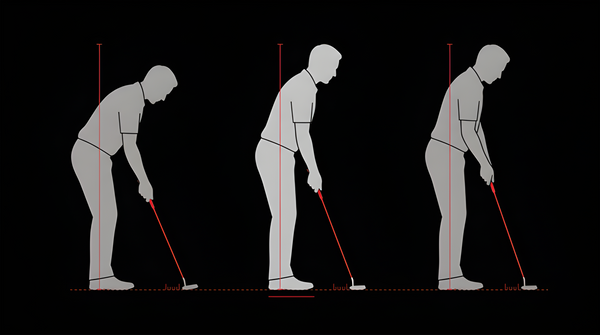
| Slight arc (1-2 inches inside) | Quarter to half toe hang | Mid-mallet, short slant or flow neck |
| Moderate arc (2-4 inches inside) | Half to three-quarter toe hang | Blade or mid-mallet, plumber's neck |
| Strong arc (4+ inches inside) | Three-quarter to full toe hang | Blade, heel shaft |
These are guidelines, not laws. Personal preference matters. Some golfers with a slight arc prefer the stability of a face balanced mid-mallet and compensate with timing. It works, but it adds a variable. The cleaner path is to match the putter's natural tendency to your stroke's natural tendency.
Hosel changes everything
Two putters with the same head shape can have completely different balance depending on the hosel. A mallet with a plumber's neck will have more toe hang than the same mallet with a center shaft. A blade with a flow neck has less toe hang than the same blade with a heel shaft.
When you test putters, test them with the hosel you intend to play. The head shape is not the whole story. The hosel is what determines the balance.
The Axis Nobody Talks About
Face balance and toe hang affect how the putter rotates through impact. That is the horizontal axis. Face angle. Direction. Whether the ball starts where you aimed.
It is the axis every putter fitting focuses on. It is the axis every comparison article covers. It is the axis every brand optimizes for: MOI, alignment aids, toe-heel weighting, groove patterns.
But there is a second axis. The vertical axis. It controls something different: how the ball launches off the face. How long it skids. How far it rolls. Distance. Here is what actually governs the vertical axis, and why your fixed loft works against you.
Face balance controls where the ball starts. It does not control where the ball stops.
On every putt, your hands deliver the putter at a slightly different position. Press forward: you subtract loft. The ball drives into the green. Hang back: you add loft. The ball pops up. Same putter, same stroke intention, different distance.
This happens to face balanced putters. It happens to toe hang putters. It happens to blades and mallets and everything in between. Because the variable is not the balance type. It is the face. And every flat face responds to hand variation the same way: inconsistently.
You matched your balance to your stroke. Good. That solves direction. But the question that remains is: what solves distance?
Not sure which balance matches your stroke?
Answer a few quick questions about your stroke and the miss that bugs you most. We'll match you to the putter built for your game.
Take the quizWhere the Curved Face Fits In
The debate between face balanced and toe hang is about matching the putter's rotation to your stroke. That is the right starting point. Pick the balance that suits your arc. Then ask a different question: what does the face do?
On a curved face, the loft varies continuously from bottom to top. When your hands press forward, the face tilts forward and loses loft, and the ball meets a part of the curve that has more loft. When your hands hang back, the face gains loft, and the ball meets a part of the curve with less loft. So the loft at impact changes much less than on a flat face. Launch is more consistent from putt to putt.
This is not a direction fix. It is a distance fix. And it works regardless of whether the putter is face balanced or toe hang.
Two stroke types. Same curved face.
Myvicto builds the curved face into every model across the lineup. The balance type changes. The face does not.


The B-Series is a blade with three hosels: 55 or 35 degrees of toe hang, or face balanced with the long L hosel. CNC-milled from 6061 aluminium. With the S or M hosel, it suits arc stroke players who want a compact head that rotates freely through impact.
The Z-Series is a mid-mallet with a center, direct or offset shaft position. In the direct position it has full toe hang (90 degrees). Higher MOI.
Both share the same curved face geometry. Both deliver the same three advantages:
- Loft adapts to hand position. Your hands shift. The face compensates. Launch is more consistent from putt to putt.
- Contact happens at the equator. The ball leaves the face on a flatter line, so the skid is shorter and more consistent. That makes your distance easier to control.
- The vertical sweet spot expands. From 1-2mm on a flat face to approximately 6mm.
The real choice is not face balanced versus toe hang. Both are important. Both have a correct answer for your stroke. The real choice is flat face versus curved face. One adapts to your hands. The other does not. See how the curved face works.
Find Your Putter
Two decisions determine whether your putter fits your game.
First: match the balance to your stroke. Face balanced for straight strokes. Toe hang for arc strokes. The degree of toe hang should match the degree of your arc. This controls direction.
Second: consider the face. A flat face has one loft. Your hands deliver a different effective loft on every stroke. A curved face adapts. The launch is more consistent. The distance tightens. This controls where the ball stops.
Most golfers get the first decision right and never know the second exists.
Find Which Putter Matches Your Stroke
Answer a few quick questions about your stroke and the miss that bugs you most. We'll match you to the putter built for your game.
Take the quizFrequently Asked Questions
What does face balanced mean on a putter?
A face balanced putter has its center of gravity aligned with the shaft axis. When balanced on a finger, the face points to the sky. It resists rotation during the stroke and suits golfers with a straight-back, straight-through putting motion.
How do I know if my putter is face balanced or toe hang?
Balance the shaft across one finger near the grip. Let the head hang freely. If the face points up, it is face balanced. If the toe drops toward the ground, it has toe hang. The degree of drop indicates how much toe hang: 45 degrees is moderate, 90 degrees is full.
Is face balanced better than toe hang?
Neither is better universally. Face balanced suits straight strokes. Toe hang suits arc strokes. The right choice depends on how your putter moves naturally through the stroke. Most golfers have some degree of arc, so they benefit from some amount of toe hang.
Can a blade putter be face balanced?
Yes, but it requires a center shaft or specific hosel geometry that moves the center of gravity under the shaft axis. Face balanced blades exist but are uncommon. Most blades have some degree of toe hang due to the traditional heel-weighted design.
What is the best face balanced putter?
The best face balanced putter matches your stroke, feels comfortable at address, and delivers consistent distance. For a straight stroke player who wants face balance with a curved face for distance consistency, the myvicto B-Series or C-Series, fitted with the long L hosel, is face balanced and has loft compensation built into its curved face.
Does putter balance affect distance control?
Putter balance primarily affects direction by controlling face rotation through impact. Distance control depends on a different variable: the effective loft at impact, which changes based on hand position. A curved face compensates for that variation. A flat face does not. Balance type (face balanced or toe hang) does not solve the distance problem.
Related guides
- How to Choose a Putter: The Complete Guide
- Best Putter for Arc Stroke (2026)
- Mallet vs Blade Putter: How to Choose
- How the Curved Face Works
- Free Putter Fitting Experience