Putter Loft Explained: Why Your Hands Change Everything
Standard putter loft is 3 to 4 degrees. But that number only tells half the story. Your effective loft changes with every stroke based on hand position at impact. Press forward and you subtract loft. Hang back and you add it. Same putter, different launch, different distance.
What Is Putter Loft?
Putter loft is the angle of the face relative to a vertical plane at address. A putter with 3 degrees of loft has a face that tilts back 3 degrees from perfectly upright. Every putter has loft. Even the ones that look flat to the naked eye.
Why does a putter need loft at all? Because the ball sits in a slight depression on the green. At address, the ball sinks roughly 0.5mm into the turf. Without loft, the face would drive the ball into the ground at impact. The ball would bounce and skid unpredictably before finding its roll.
Loft lifts the ball out of that depression and onto the surface of the green. The right amount of loft produces a brief airborne phase (fractions of a second), then the ball lands and transitions into forward roll. Too little loft: the ball drives down, bounces, and the distance becomes unpredictable. Too much loft: the ball pops up, lands with backspin, and checks before rolling. Either way, you lose distance control.
The goal is a launch angle between 1.5 and 4 degrees at impact. That window produces the smoothest transition from skid to roll. Quintic ball roll studies and SAM PuttLab data confirm this consistently across handicap levels.
How Hand Position Changes Effective Loft
Here is where most golfers stop reading about putter loft. And where the real story begins.
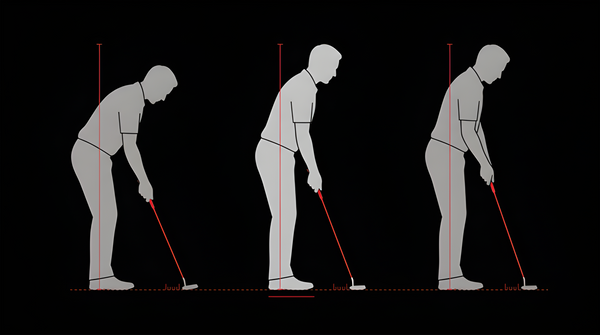
Your putter might have 3 degrees of static loft. That is the number stamped on the spec sheet. But static loft is measured at neutral address with zero hand press. The moment your hands move forward or back at impact, the effective loft changes.
Press your hands 2 degrees forward of neutral. Your 3-degree putter now has 1 degree of effective loft. The ball drives into the green. It bounces. The first moments after impact are chaos, and your distance control suffers.
Let your hands fall 2 degrees behind neutral. Your 3-degree putter now has 5 degrees of effective loft. The ball launches high, lands with more backspin, and stops shorter than intended.
The mathematics are simple. Your effective loft at impact equals the static loft of your putter minus (or plus) the angle your hands create relative to neutral. Every degree matters.
How much do hands actually move?
More than you think. PING fitting data shows that even consistent putters vary hand position by 2 to 4 degrees between strokes. Under pressure, that number increases. On fast greens, it increases again. On a pressure putt at a pace you have not practiced, the variation can reach 5 to 6 degrees.
That means your 3-degree putter can deliver anywhere from -1 to 9 degrees of effective loft during a single round. One putter. One golfer. A 10-degree loft range on the putting green.
This is not a flaw in your stroke. It is physics. Your hands are never in the same position twice. A flat face with a single fixed loft cannot account for that.
Curious how this connects to putter selection? Our complete guide to choosing a putter covers every spec that matters.
Standard Loft by Putter Type
Different putter styles ship with different loft angles. The standard has settled around 3 to 4 degrees, but variations exist across brands and head types.
| Putter Type | Typical Loft Range | Common Default | Notes |
|---|---|---|---|
| Blade (Anser-style) | 2 to 4 degrees | 3 to 3.5 degrees | Classic compact head. Most blades ship at 3 to 3.5. |
| Mid-mallet | 2.5 to 4 degrees | 3 to 4 degrees | Deeper CG can influence optimal loft. Some fitters add 0.5 degree. |
| Full mallet | 2 to 4 degrees | 3 degrees | Higher MOI designs tend toward lower loft for a cleaner roll. |
| Insert face (polymer) | 3 to 5 degrees | 4 degrees | Softer inserts often need slightly more loft to get the ball rolling. |
| Milled face (steel/aluminium) | 2 to 4 degrees | 3 degrees | Harder face materials produce more immediate ball speed. |
These are starting points. The right loft for you depends on how you deliver the putter at impact. A golfer who consistently presses forward needs more static loft to arrive at the correct effective loft. A golfer who plays the ball forward in the stance with no hand press might need less.
How to check your current putter loft
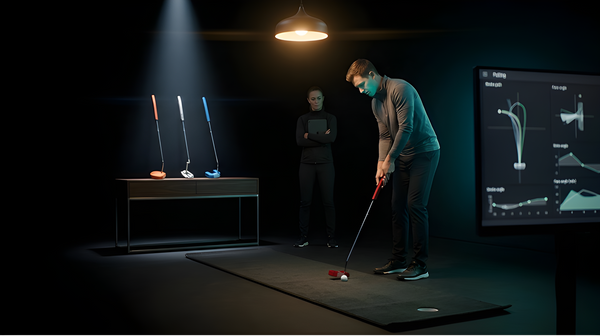
Most putter specs are listed on the manufacturer's website or stamped on the head. If you cannot find it, a local clubfitter can measure it with a loft/lie gauge in under a minute. What you really want to know is your dynamic loft at impact, which requires a putting launch monitor (Quintic, SAM PuttLab, or Capto). That dynamic number is what actually launches the ball.
Loft and Lie: How They Work Together
Putter loft and lie angle are related but separate. Loft is the vertical angle of the face. Lie is the angle between the shaft and the ground at address. They interact more than most golfers realize.
When your lie angle is correct, the sole of the putter sits flat on the ground at address. The loft you see is the loft you get. When the lie angle is wrong, the putter sits with the toe up or the heel up. That tilt changes the effective aim and can add or subtract effective loft at the edges of the face.
Standard lie angle for most putters is 70 degrees. Tall golfers with an upright posture often need 72 to 74 degrees. Shorter golfers or those with more bend may need 68 to 70. A lie angle error of 2 degrees can push the ball offline by over a foot on a 15-foot putt.
The interaction
If your lie angle is off, fixing the loft alone will not solve the problem. And if your loft is off, a perfect lie angle will not compensate. They need to be set together. This is why fitters always measure both in a single session.
A putter with 3 degrees of loft and 70 degrees of lie is calibrated for one address position. Change the lie, and the loft delivery changes with it. Change the loft, and you might need to adjust the lie to keep the aim consistent. The two specs are linked.
Understanding your stroke type helps with both decisions. Our arc stroke putter guide covers how stroke path connects to loft and lie.
The Loft-Distance Connection
Distance control is the single biggest factor in reducing three-putts. Not line. Not read. Distance. A putt that finishes within a 3-foot circle around the hole will go in most of the time. The question is whether you can land the ball in that circle consistently.
Loft plays a direct role. The launch angle determines how long the ball skids before it starts rolling. Skid distance is unpredictable because it depends on green speed, grain direction, moisture, and surface firmness. The longer the skid phase, the more variables affect the putt. The shorter the skid, the sooner the ball behaves predictably.
What happens with too little effective loft
The ball drives into the green. It bounces once or twice in the first moments after impact. Each bounce adds friction unpredictably. The ball decelerates in bursts rather than a smooth curve. On a 20-foot putt, this can add or subtract 2 to 3 feet from the stopping point.
What happens with too much effective loft
The ball launches high. It travels several inches through the air before landing. On landing, backspin is still active, which momentarily checks the ball. Then it releases and rolls forward. But the check point varies with green speed. On fast greens, the ball checks harder and stops short. On slow greens, the check is minimal and the ball rolls past.
The sweet spot: 1.5 to 4 degrees at impact
Research from Quintic and independent putting labs shows that an effective loft of 1.5 to 4 degrees at impact produces the shortest skid phase and most predictable roll. That is a tight window. And your hands need to deliver the putter within that window on every stroke.
For a putter with 3 degrees of static loft, that means your hands need to return within 1.5 degrees of neutral. Every time. On every putt. Under all conditions.
That is a lot to ask of any golfer.
What if the Face Could Adapt?
Everything above describes a real problem with no traditional solution. Your putter has one loft. Your hands deliver a different effective loft on every stroke. The gap between those two numbers costs you distance consistency.
Fitting can narrow the gap. A fitter can set your static loft to match your average hand position at impact. But that average is exactly that: an average. Half your strokes will be above it. Half will be below. The variation does not disappear. If you want the full breakdown of how loft fits alongside length, lie, weight, and grip in a proper putter fitting session, read our guide on what a real fitting covers.
Adding more loft helps golfers who press forward. Reducing loft helps golfers who hang back. But no single fixed number can cover both tendencies in the same player across 18 holes of varying pressure, speed, and slope.
Your hands change position on every putt. A single fixed loft cannot follow them.
The question is straightforward: what if the face had more than one loft? What if the loft adjusted based on where you struck the ball, which changes based on where your hands were at impact?
That is loft compensation. And it is exactly what a curved face does.
Want to see your actual dynamic loft?
Answer a few quick questions about your stroke and the miss that bugs you most. We'll match you to the putter built for your game.
Take the quizHow the Curved Face Solves the Loft Problem
A curved face is convex. Instead of one loft angle across the entire face, the loft varies continuously from bottom to top. Less loft at the bottom. More loft at the top. An infinite number of loft planes across the face surface.
When your hands press forward at impact, the ball strikes higher on the face where there is more loft. The additional loft compensates for the de-lofting that your hand position created. Launch stays in the optimal window.
When your hands hang back, the ball strikes lower on the face where there is less loft. The reduced loft compensates for the extra loft your hand position added. Launch stays in the optimal window.
Your hands move. The launch does not.
Three advantages from one curve
- Loft adapts to hand position. The curved geometry matches the face loft to the strike location, which is determined by hand position. The result: consistent launch angle regardless of where your hands sit at impact.
- Contact stays above the equator. The convex shape ensures the ball is always struck just above its center line. That produces immediate forward spin. Skid is reduced. The ball gets into true roll faster and holds its line better through the first moments after impact.
- The vertical sweet spot expands. A flat face has 1 to 2mm of vertical sweet spot. A curved face: approximately 6mm. The impact factor stays constant at 1.60 to 1.62 across the entire ellipse. Same energy transfer whether contact is perfect or off by a few millimeters.
Consider what this means for the loft problem described above. A 15-handicap golfer varies hand position by 2 to 4 degrees between strokes. On a flat face, that variation translates directly into 2 to 4 degrees of loft variation. On a curved face, the geometry absorbs the variation. The effective launch stays within the optimal 1.5 to 4 degree window.
You still need to be fitted for the right static loft starting point. But the margin of error expands dramatically. Your worst stroke launches closer to your best stroke. The distance spread tightens. The three-putt count drops.
Every myvicto model has the curved face
The B-Series (blade, toe hang) and the Z-Series (mid-mallet, face balanced) share the same curved face technology. CNC-milled from 6061 aluminium in a Swiss workshop. The head shape and balance type differ. The face geometry is identical.


The choice between blade and mallet depends on your stroke type and preference. The loft compensation works the same either way. See how the curved face works in detail.
Find Your Ideal Loft Setup
Putter loft is not a set-and-forget number. It is a variable that changes with every stroke because your hands change with every stroke. Understanding that is the first step toward better distance control.
The second step is deciding what to do about it. You can get fitted for a static loft that matches your average hand position. That helps. Or you can use a face that adapts to every hand position. That solves the problem at the source.
Find the Right Loft for Your Stroke
Answer a few quick questions about your stroke and the miss that bugs you most. We'll match you to the putter built for your game.
Take the quizFrequently Asked Questions
What is the standard loft on a putter?
Most putters ship with 3 to 4 degrees of loft. Blades tend toward 3 to 3.5. Mallets are often 3 to 4. Insert-face putters may go up to 5. The standard across the industry has settled at approximately 3.5 degrees.
Why do putters have loft?
A golf ball sits slightly below the surface of the green at address. Loft lifts the ball out of that depression and onto the putting surface. Without loft, the ball would drive into the ground at impact, bounce unpredictably, and roll with inconsistent speed.
What happens if my putter loft is too low?
The ball drives into the turf at impact. It bounces in the first moments after contact, skids inconsistently, and the distance becomes unpredictable. Golfers who press their hands forward at impact are especially affected because the forward press subtracts loft from the already-low starting angle.
What happens if my putter loft is too high?
The ball launches high off the face, travels through the air longer than necessary, and lands with active backspin. The backspin checks the ball on landing, and the stopping point varies with green speed. On fast greens, the ball stops too short. On slow greens, the check is less noticeable and the ball rolls past.
How does hand position affect putter loft?
Pressing your hands forward at impact subtracts from the static loft. Letting your hands fall behind adds to it. A 3-degree putter with 2 degrees of forward press delivers 1 degree of effective loft. The same putter with 2 degrees of hang-back delivers 5 degrees. Most golfers vary hand position by 2 to 4 degrees between strokes.
What is loft compensation in a putter?
Loft compensation means the face adjusts effective loft based on where the ball is struck. On a curved (convex) face, the loft varies continuously from bottom to top. When hands press forward, the strike moves higher on the face where there is more loft. When hands hang back, the strike moves lower where there is less loft. The launch angle stays consistent regardless of hand position.
Related guides
- How to Choose a Putter: The Complete Guide
- Best Putter for Arc Stroke (2026)
- How the Curved Face Works
- Free Putter Fitting Experience