How to Grip a Putter: Guide to Grip Styles and Sizes (2026)
Grip your putter with even pressure in both hands, the shaft running through your palms rather than your fingers. The reverse overlap is the most common style. But grip style and grip size both change where your hands sit at impact. That changes effective loft. And that changes distance.
Types of Putting Grips
There is no single correct way to hold a putter. Tour professionals use at least five distinct grip styles. Each one changes where the hands sit on the shaft, how much wrist action enters the stroke, and how the forearms engage. The right grip depends on your stroke mechanics, comfort, and what you are trying to control.
Reverse overlap
The standard. Used by the majority of tour professionals and the default taught by most instructors. The left index finger extends down across the fingers of the right hand, overlapping them. Both thumbs sit flat on the top of the grip.
This grip connects both hands as a single unit. The overlapping left index finger locks the hands together and reduces independent wrist movement. It promotes a pendulum motion driven by the shoulders and arms. If you have never experimented with other styles, this is where most golfers start and many stay.
Best for: Players who want a traditional feel with moderate wrist control. Works with any stroke type.
The claw (or claw grip)
The lead hand (left for right-handed golfers) holds the putter conventionally. The trail hand changes. Instead of wrapping around the grip, the trail hand rests against it with the fingers pointing downward. The thumb and index finger form a channel that guides the shaft.
The claw became mainstream when Chris DiMarco used it on Tour. It removes the trail hand from the equation almost entirely. The trail hand cannot torque the putter or influence the face angle at impact. All control shifts to the lead hand and the larger muscles of the arms and shoulders.
Best for: Players who fight the yips or have overactive trail hand involvement. Particularly effective for golfers who pull putts left (right-handed) because the trail hand was closing the face.
Cross-handed (left hand low)
The hand positions swap. For right-handed golfers, the left hand moves below the right on the grip. This reverses the traditional hierarchy. The lead shoulder stays level through impact instead of dipping.
Jordan Spieth used this grip to become one of the best putters on Tour during his major championship wins. The cross-handed grip levels the shoulders at address, which helps the putter swing on a consistent arc. It also locks the lead wrist, preventing it from breaking down through impact.
Best for: Players who struggle with a breakdown in the lead wrist through impact. Effective for golfers whose lead shoulder drops, causing inconsistent contact height on the face.
Arm lock
The grip extends up the lead forearm. The butt of the putter presses against the inside of the lead forearm, and the lead wrist is effectively locked into a single position. The putter becomes an extension of the forearm.
Matt Kuchar popularized this style. It requires a longer putter (typically 38-41 inches versus the standard 33-35) and a grip that accommodates forearm contact. The USGA considered restricting arm lock putters but has allowed them under current rules.
Best for: Players who want to eliminate all wrist movement. Works particularly well for golfers with a straight-back, straight-through stroke.
If you already know your grip and stroke type, our fitting experience matches everything to the right putter configuration.
Prayer grip (palms facing)
Both palms face each other with the grip running between them. The thumbs press together on top. The fingers interlock or sit side by side. This neutralizes both wrists equally.
The prayer grip distributes pressure evenly between both hands. Neither hand dominates. It creates a stable, low-torque setup that works well with oversized grips. Brendon Todd used a variation of this grip to win three times in 2019 after rebuilding his putting stroke.
Best for: Players seeking equal pressure distribution. Pairs naturally with larger grip sizes.
Grip Size: How It Affects Your Stroke
Grip size is not about hand size. That is the most common misconception in putter fitting. SuperStroke, the largest putter grip manufacturer, emphasizes that stroke style should drive grip size selection. Not hand measurement.
There are three main categories.
Standard size
The smallest option. Diameter around 1.0 inches. Allows maximum feel and wrist involvement. The fingers wrap fully around the grip, activating the small muscles in the hands and wrists.
Who benefits: Low handicappers with a reliable stroke who want maximum feedback. Players with smaller hands. Golfers who use wrist action intentionally in their stroke.
Midsize
Diameter between 1.2 and 1.4 inches. Reduces wrist action without eliminating it. The hands still engage but the larger diameter dampens involuntary movements. This is the fastest-growing category in putter grips.
Who benefits: The majority of amateur golfers. Players transitioning from standard who want more stability without losing all feel. Golfers with an average grip.
Oversized / jumbo
Diameter up to 1.75 inches (the maximum allowed under the Rules of Golf). The oversized putter grip transfers stroke control almost entirely to the shoulders and arms. Wrist action becomes physically difficult. The hands become passengers.
Who benefits: Golfers who fight involuntary wrist movement. Players with the yips. Higher handicappers who want a more repeatable stroke. Golfers with arthritis who need a more comfortable hold. Players with large hands.
How size changes mechanics
| Grip Size | Diameter | Wrist Action | Feel / Feedback | Best Stroke Type |
|---|---|---|---|---|
| Standard | ~1.0" | High | Maximum | Any (experienced players) |
| Midsize | 1.2-1.4" | Moderate | Good | Any |
| Oversized | 1.4-1.75" | Low | Reduced | Shoulder-driven |
A critical detail most grip guides skip: grip size changes hand position at address. A larger grip pushes the hands slightly higher. A smaller grip lets them sit lower. That positional difference changes the effective loft at impact. We will come back to this.
Popular Putter Grips Reviewed
Three brands dominate the putter grip market. Each has a different philosophy.
SuperStroke
The brand that made oversized putter grips mainstream. SuperStroke's signature feature is No Taper Technology. Traditional grips taper from thick at the top to thin at the bottom. SuperStroke grips maintain the same diameter from top to bottom. This creates even pressure in both hands.
The Traxion line is their flagship. Tacky polyurethane outer layer with a textured surface. Available in every size from the slim S-Tech 1.0 to the massive Traxion Tour 5.0. The CounterCore weight system adds a removable weight in the butt end, shifting the balance point for a more stable feel.
Popular models: Traxion Tour 2.0 (midsize, most versatile), S-Tech (slim, maximum feel), Traxion Claw (shaped specifically for the claw grip style).
Golf Pride
The oldest name in golf grips. Golf Pride's putter grip line is smaller than SuperStroke's but focuses on traditional shapes. The Pro Only series is their premium offering. Cord options (Red Star) provide a firmer, more textured feel in wet conditions. The Blue Star is a softer rubber compound.
Golf Pride grips use traditional tapering. The top is thicker than the bottom. Some players prefer this because it creates differentiated pressure between the hands. The lead hand feels more contact surface, encouraging it to guide the stroke.
Popular models: Pro Only Red Star (cord, firm feel), Pro Only Blue Star (rubber, soft feel), Tour SNSR Contour (ergonomic shape, fills the palm).
Lamkin
Known for their Sink Fit line. Lamkin uses a proprietary Genesis material that combines rubber and cord-like texture without actual cord. The result is a grip that provides traction without the harshness of full cord.
Their deep etched pattern is distinctive. Micro-texture throughout the grip surface. Lamkin offers both tapered and non-tapered options across the Sink Fit range.
Popular models: Sink Fit Standard (classic shape, Genesis material), Sink Fit Rubber Pistol (pistol-shaped, wider base), Sink Fit Skinny (for players who prefer slim profiles).
How to Regrip Your Putter
Regripping a putter takes 10 minutes and basic tools. You do not need a pro shop.
What you need
- New grip
- Grip tape (double-sided)
- Grip solvent (or mineral spirits)
- Utility knife
- Vice with rubber clamp (optional but helpful)
Steps
- Remove the old grip. Cut lengthwise with the utility knife from top to bottom. Peel off. Remove the old tape underneath with solvent.
- Apply new tape. Wrap double-sided grip tape around the shaft. Start half an inch below the top and spiral down to cover the grip area. Leave a quarter inch of tape over the butt end. Twist to seal.
- Activate the tape. Pour grip solvent over the tape, rotating the shaft to coat the entire surface. Pour solvent inside the new grip as well. Plug the hole at the top with your finger and shake.
- Slide the grip on. Align the flat top (if applicable) with the putter face. Push the grip on in one smooth motion. You have about 30 seconds before the solvent dries and the grip locks.
- Align and set. Check the alignment mark against the putter face. Adjust if needed. Let it dry for 4 to 8 hours before use.
Replace your putter grip every 40 to 60 rounds. A worn grip changes texture, absorbs moisture, and shifts your hand position. Even a millimeter of hand shift changes the effective loft at impact.
Matching Grip to Hand Size
Hand size is a secondary factor. Stroke style comes first. But once you know the size category that matches your stroke, your hand measurement fine-tunes the selection within that category.
| Hand Length (middle finger to wrist crease) | Glove Size | Starting Recommendation |
|---|---|---|
| Under 7" | S / M-L | Standard or slim midsize |
| 7" to 8.5" | M-L / L | Midsize |
| Over 8.5" | XL / XXL | Midsize or oversized |
This is a starting point. The real test is on the green. Grip 10 putts with the size you think is right. Then grip 10 with the next size up. The size that produces a tighter distance cluster on 20-foot putts is the right one. Not the one that feels most natural. The one that performs.
One more variable: grip shape. Pistol grips angle the bottom, which pushes the trail hand slightly forward. Paddle grips keep the hands level. Flat-top grips encourage the thumbs to sit directly on top, promoting a palms-facing setup. Each shape changes hand position by a few millimeters. Those millimeters matter at impact.
The Connection Between Grip and Distance
Every section above changes one thing: where your hands sit on the shaft and at what angle they arrive at impact.
A claw grip positions the trail hand differently than a reverse overlap. A cross-handed grip levels the shoulders, shifting the hands forward. An oversized grip raises the hands slightly. A pistol shape angles the wrist. Even switching from a tapered to a non-tapered grip repositions the pressure points by millimeters.
Those millimeters change the effective loft of a flat-faced putter.
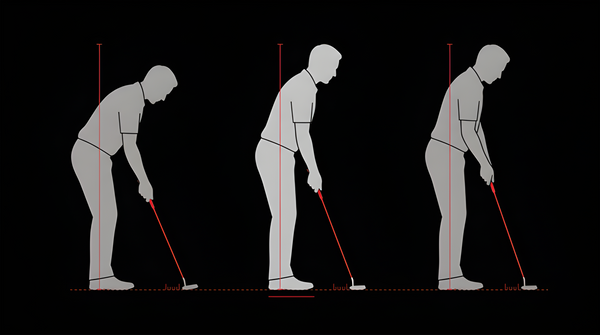
Grip affects hand position. Hand position affects effective loft. Different grips produce different launch angles on the same flat face.
Press the hands forward by 3mm and you de-loft the face. The ball drives into the ground, bounces, and rolls an unpredictable distance. Let the hands hang back 3mm and you add loft. The ball pops up, skids longer, and stops short.
On a 20-foot putt, this hand variation can produce 2 to 3 feet of distance inconsistency. Not from a bad stroke. From the normal positional differences that come with changing grip styles, grip sizes, or simply putting under pressure when your hands behave a little differently than they did on the practice green.
You optimized the grip. You found the right size. You chose the right style. But the flat face still reacts to every millimeter of hand position change. That is a face problem. Not a grip problem.
Not sure which grip and putter match your stroke?
Answer a few quick questions about your stroke and the miss that bugs you most. We'll match you to the putter built for your game.
Take the quizWhy the Curved Face Works With Every Grip Style
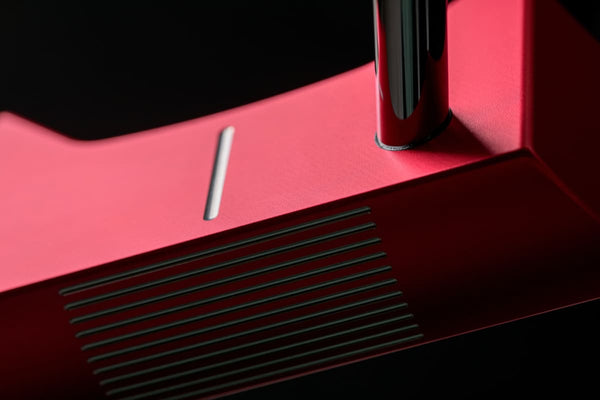
On a curved face, the loft varies continuously from the bottom to the top. There is no single fixed loft. Instead, the face provides a gradient that adapts to where the ball is struck.
When your hands press forward (common with a claw or cross-handed grip), the face tilts forward and loses loft, and the ball meets a part of the curve that has more loft. When your hands sit back, the face gains loft, and the ball meets a part of the curve with less loft. So the loft at impact changes much less than on a flat face.
The result: more consistent launch, whatever your grip style. A golfer who switches from reverse overlap to claw does not need to adjust the putter. The curved face absorbs the hand position change that the new grip introduces.
Three things happen simultaneously with the curved face:
- Loft adapts to hand position. Your grip style places your hands somewhere on the shaft. The face compensates for wherever that position lands. Different grip, more consistent launch.
- Contact happens at the equator. The ball leaves the face on a flatter line, so the skid is shorter and more consistent. That makes your distance easier to control.
- The vertical sweet spot expands. 6mm versus 1-2mm on a flat face.
The curved face works exclusively on the vertical axis: distance consistency. Direction remains the golfer's responsibility: stroke path, face angle, and alignment.
The myvicto configurator lets you pair your preferred grip with the right head shape and hosel. Every combination uses the same curved face. Blade or mallet. Standard grip or oversized. Reverse overlap or claw. The face adapts.


Choose the grip style that suits your stroke. Choose the size that matches your mechanics. The curved face handles the loft variation that every grip introduces. See how putter loft works.
Find Your Setup
The grip is where your body meets the putter. It determines hand position, wrist action, and pressure distribution. The face is where the putter meets the ball. It determines launch angle, spin, and distance consistency.
Optimize both. Not one.
Most golfers spend hours testing grip styles and sizes but never question what happens at the other end of the shaft. A curved face makes every grip style more forgiving on the vertical axis. Not a replacement for good grip mechanics. A complement to them.
Find the Right Grip and Putter Together
Answer a few quick questions about your stroke and the miss that bugs you most. We'll match you to the putter built for your game.
Take the quizFrequently Asked Questions
What is the most common putter grip style?
The reverse overlap. Both hands work as a unit with the left index finger extending over the right hand fingers. Used by the majority of tour professionals and taught as the default by most instructors. It provides balanced control with moderate wrist involvement.
What size putter grip should I use?
Start with your stroke style, not hand size. If you want to reduce wrist action, go midsize or oversized. If you want maximum feel and feedback, stay standard. Within that category, hand size fine-tunes the selection. Most amateurs benefit from midsize as a starting point.
Does an oversized putter grip help with the yips?
Often yes. An oversized grip makes it physically harder for the wrists to twitch or break down through impact. It shifts control to the larger muscles of the arms and shoulders. Many golfers who struggled with the yips found relief with oversized grips, often combined with a claw or prayer grip style.
How often should I regrip my putter?
Every 40 to 60 rounds. A worn grip changes in texture and tackiness, which shifts hand position by small amounts. Even a millimeter of hand shift changes the effective loft at impact. If your putter grip feels slick or hard, it is past due.
Does putter grip size affect distance control?
Yes. Grip size changes hand position at address, which changes the effective loft on a flat face. Larger grips raise the hands slightly. Smaller grips let them sit lower. Each position produces a different launch angle. A curved face compensates for these differences by varying loft continuously across the face.
Can I use a SuperStroke grip on any putter?
Yes. SuperStroke grips use a standard installation process and fit any putter shaft. The CounterCore weight system adds a removable weight in the butt end. Check that the grip length covers your intended hand position. On putters with longer shafts (arm lock style), you may need an extended grip model.
Related guides
- How to Choose a Putter: The Complete Guide
- Putter Fitting Guide: What Actually Matters
- Putter Loft Explained: Why It Matters More Than You Think
- How the Curved Face Works
- Free Putter Fitting Experience