How to Measure Putter Length: Height Chart + Fitting Guide (2026)
Standard putter length is 33 to 35 inches. To find your ideal length, stand naturally with your arms hanging straight down. Measure from the crease of your wrist to the floor. That measurement, adjusted for your putting posture, gives you the baseline. The height chart below maps your height to a recommended putter length.
Standard Putter Lengths
Not sure which putter fits your stroke? Take the 60-second quiz and we will match you.
Take the quiz →Most putters sold off the rack come in one of three standard lengths.
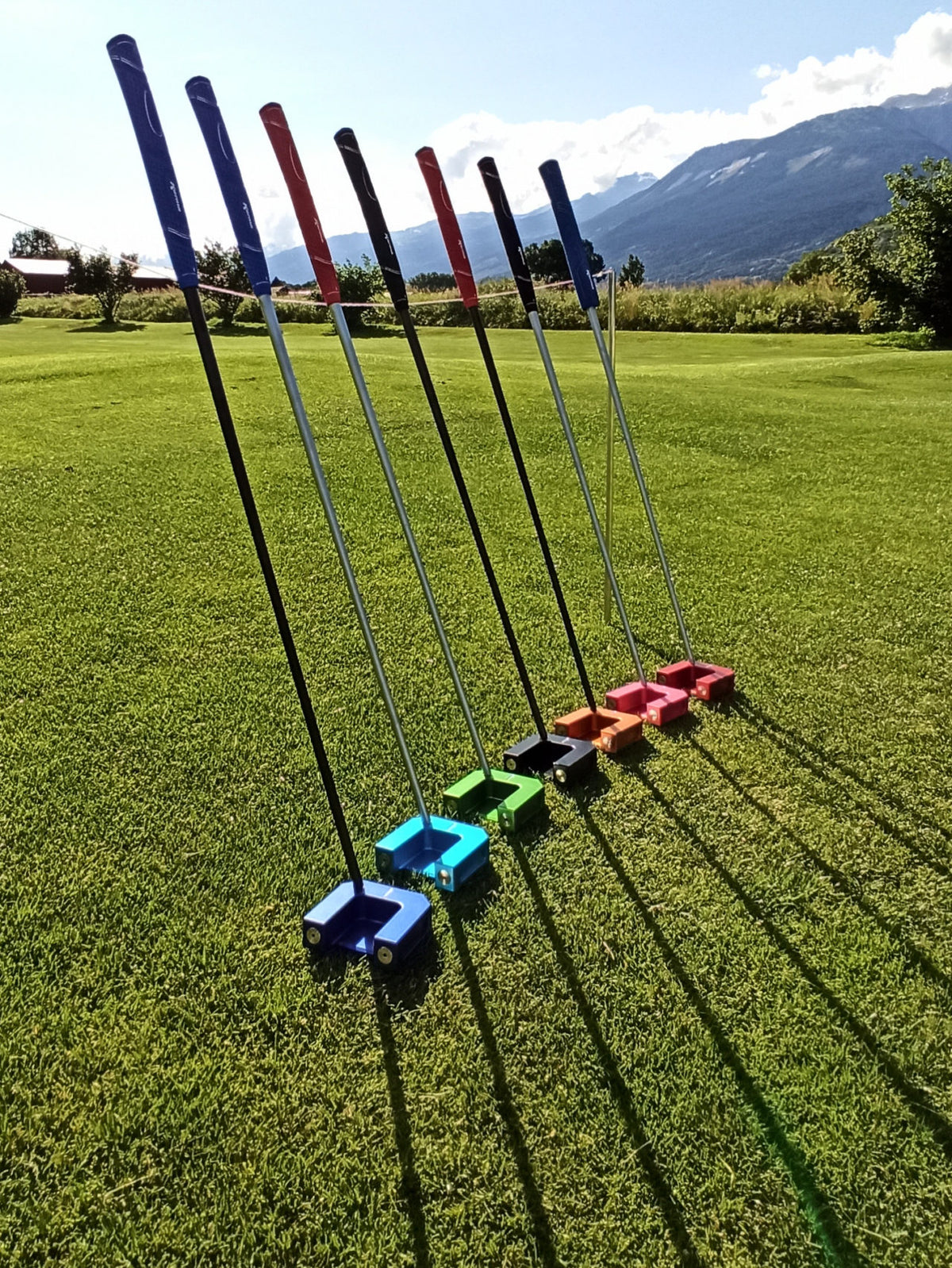
- 33 inches: Designed for golfers roughly 5 feet 4 inches to 5 feet 7 inches. Shorter golfers usually need 31 to 32.5 inches (see the chart below). Less common on retail shelves. Often requires a special order.
- 34 inches: The most common standard length. Designed for golfers roughly 5 feet 8 inches to 5 feet 11 inches. This is the length you will find on most putters in a pro shop.
- 35 inches: Designed for golfers roughly 6 feet to 6 feet 3 inches. Golfers 6 feet 4 inches and taller usually need 35.5 to 36 inches. The second most common off-the-rack option.
The 34-inch standard fits the statistical average. But golfers are not averages. Your arm length, putting posture, and eye position all influence the ideal length. Two golfers who are both 5 feet 10 inches may need different putter lengths if one has longer arms or a more upright stance.
The height chart below gives you a starting point. The measuring method that follows gives you precision.
Putter Length by Height: The Complete Chart
This chart maps golfer height to recommended putter length. It is a starting point. Your wrist-to-floor measurement and natural posture may shift you half an inch in either direction.
| Golfer Height | Height (cm) | Recommended Putter Length | Putter Length (cm) |
|---|---|---|---|
| 5'0" to 5'1" | 152 to 156 cm | 31" to 32" | 79 to 81 cm |
| 5'2" to 5'3" | 157 to 162 cm | 32" to 32.5" | 81 to 83 cm |
| 5'4" to 5'5" | 163 to 167 cm | 32.5" to 33" | 83 to 84 cm |
| 5'6" to 5'7" | 168 to 172 cm | 33" to 33.5" | 84 to 85 cm |
| 5'8" to 5'9" | 173 to 177 cm | 33.5" to 34" | 85 to 86 cm |
| 5'10" to 5'11" | 178 to 182 cm | 34" to 34.5" | 86 to 88 cm |
| 6'0" to 6'1" | 183 to 187 cm | 34.5" to 35" | 88 to 89 cm |
| 6'2" to 6'3" | 188 to 192 cm | 35" to 35.5" | 89 to 90 cm |
| 6'4" and above | 193 cm and above | 35.5" to 36" | 90 to 91 cm |
Two important notes. First, these recommendations assume a standard putting posture with a slight bend at the hips and arms hanging naturally. If you stand very upright, you may need a longer putter. If you crouch deeply, you may need a shorter one. Second, wrist-to-floor measurement is more accurate than height alone because it accounts for arm length differences. Method 1 below shows how to use it.
How to Measure at Home (Step by Step)
You need a tape measure, flat shoes or golf shoes, and someone to help you measure. This takes five minutes.
Method 1: Wrist-to-floor measurement
This is the quickest home method. It accounts for your arm length, not just your height.
- Stand straight on a flat surface. Wear your golf shoes or flat shoes. Stand upright with your shoulders relaxed and arms hanging naturally at your sides. Do not reach down.
- Measure from wrist crease to floor. Have someone measure from the crease where your wrist meets your hand straight down to the floor. Measure both hands and average the two numbers if they differ.
- Find your baseline putter length. Your wrist-to-floor measurement is your approximate starting length. Most golfers need a putter that is 1 to 2 inches shorter than this number, because putting posture bends you forward slightly. A 35-inch wrist-to-floor measurement typically translates to a 33.5 to 34-inch putter. If this length falls outside the chart range for your height, check it with Method 2 or a fitting.
- Adjust for your stance. If you putt with a more upright posture (less bend), stay closer to the wrist-to-floor number. If you crouch over the ball with significant forward bend, subtract an additional half inch.
Method 2: Posture-first measurement
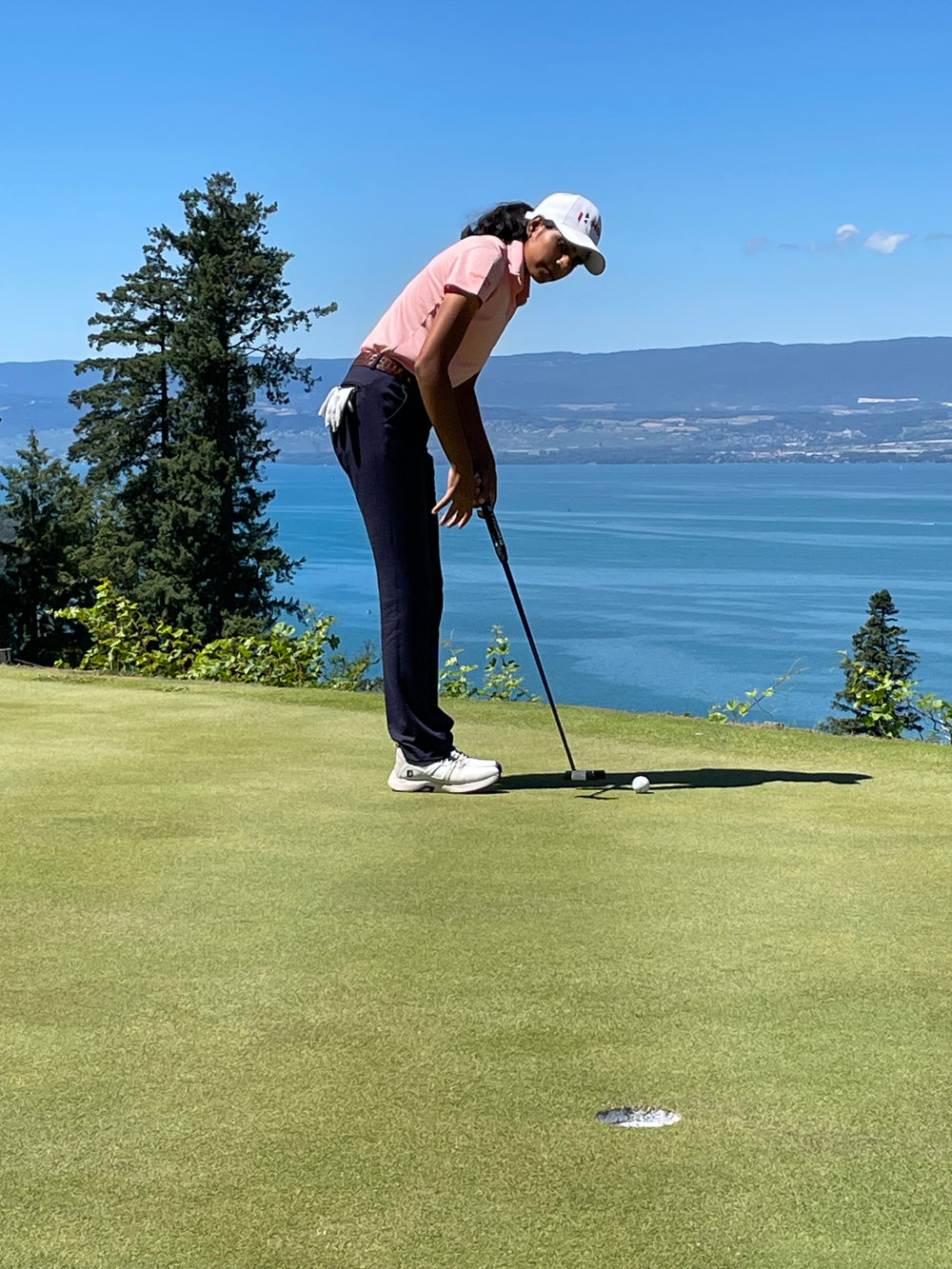
This method works if you already have a comfortable putting stance. You need a putter that is long enough for your hands to sit on the grip, a piece of tape, and someone to help.
- Take your natural putting stance. Address a ball the way you normally would. Let your arms hang straight down from your shoulders. Rest the putter with its sole flat on the ground.
- Grip the putter where your hands naturally fall. Your hands should rest below your shoulders with a very slight bend in the elbows. Do not slide your hands to the top of the grip.
- Mark half an inch above your top hand. Have someone put a piece of tape on the grip or shaft, half an inch above your top hand.
- Measure along the shaft. Keep the putter resting flat. Measure along the line of the shaft, from the point where that line meets the ground up to the tape. This number is your putter length.
Method 3: Measure your current putter
If you suspect your current putter is the wrong length but want to know by how much, measure it correctly. Rest the putter on the ground at its normal lie, with the sole flat. Measure from the top of the grip down along the line of the shaft to the point where that line meets the sole. This is how the Rules of Golf measure putter length. Compare it to the chart above and to your Method 1 result.
Signs Your Putter Is the Wrong Length
You may not need to measure at all. These signs tell you something is off.
Putter too long
- Your elbows cramp in toward your body instead of hanging naturally.
- Your eyes sit well inside the target line at address.
- The putter path feels flatter than it should.
- The toe lifts off the ground at address. This pushes aim left for right-handed golfers.
- You feel like you are standing too far from the ball.
Putter too short
- You crouch excessively. Your lower back feels tight after a round of putting.
- Your eyes sit beyond (outside) the ball at address.
- The putter path feels too upright.
- The heel lifts off the ground. This pushes aim right for right-handed golfers.
- Your arms feel extended and tense rather than relaxed.
If you see two or more of these signs, the length is likely wrong. Even half an inch matters. A putter that is too long by half an inch moves your eye position enough to change your aim line.
How Length Affects Your Stroke
Putter length is not just a comfort measurement. It directly affects three things that determine whether putts go in.
Eye position
The correct putter length places your eyes directly over the ball or slightly inside the target line. This is the position that gives you the most accurate perception of the aim line. Too long and your eyes drift inside, distorting your read. Too short and your eyes move outside, creating the same problem from the opposite direction.
Stroke path
Length changes the lie angle at address, which changes the plane of your stroke. A putter that is too long flattens the stroke plane. A putter that is too short steepens it. Neither is inherently wrong, but both change the natural arc of your stroke in ways you will unconsciously compensate for. Those compensations add inconsistency.
Posture and tension
A putter that forces you to reach or crouch creates tension in your arms, shoulders, and lower back. Tension kills smooth tempo. Smooth tempo is the foundation of distance control. Distance control is where most three-putts come from. A putter length that creates a relaxed, natural posture removes a barrier between your tempo and your results.
Know your ideal length? Read our full putter fitting guide to check the rest of your specs.
The Variable Length Alone Cannot Fix

Getting the right putter length solves the posture problem, the eye position problem, and the stroke plane problem. Those are real gains. They matter.
But length does not solve the distance problem.
Even the perfect length cannot fix inconsistent distance if your face delivers different loft on every stroke.
Here is what happens. You find your ideal length. Your posture is relaxed. Your eyes are over the ball. Your stroke is smooth. You make a good pass at it from 25 feet.
On the first putt, your hands press forward slightly at impact. The effective loft drops. The ball comes off low, skids, and rolls past the hole.
On the second putt, same stroke, same tempo, your hands sit back about an inch. The effective loft increases. The ball launches higher, skids longer, and stops short.
That is two different distances from the same stroke. Not from a bad stroke. Not from the wrong length. From a flat face that cannot adapt to the small hand position changes that happen on every putt.
Length is one variable. Loft is another. But when the loft is fixed and your hands are not, those two variables work against each other. You solved the length equation. The face created a new one.
Find the right length and the right face
Answer a few quick questions about your stroke and the miss that bugs you most. We'll match you to the putter built for your game.
Take the quizCustom Length with a Face That Works with It
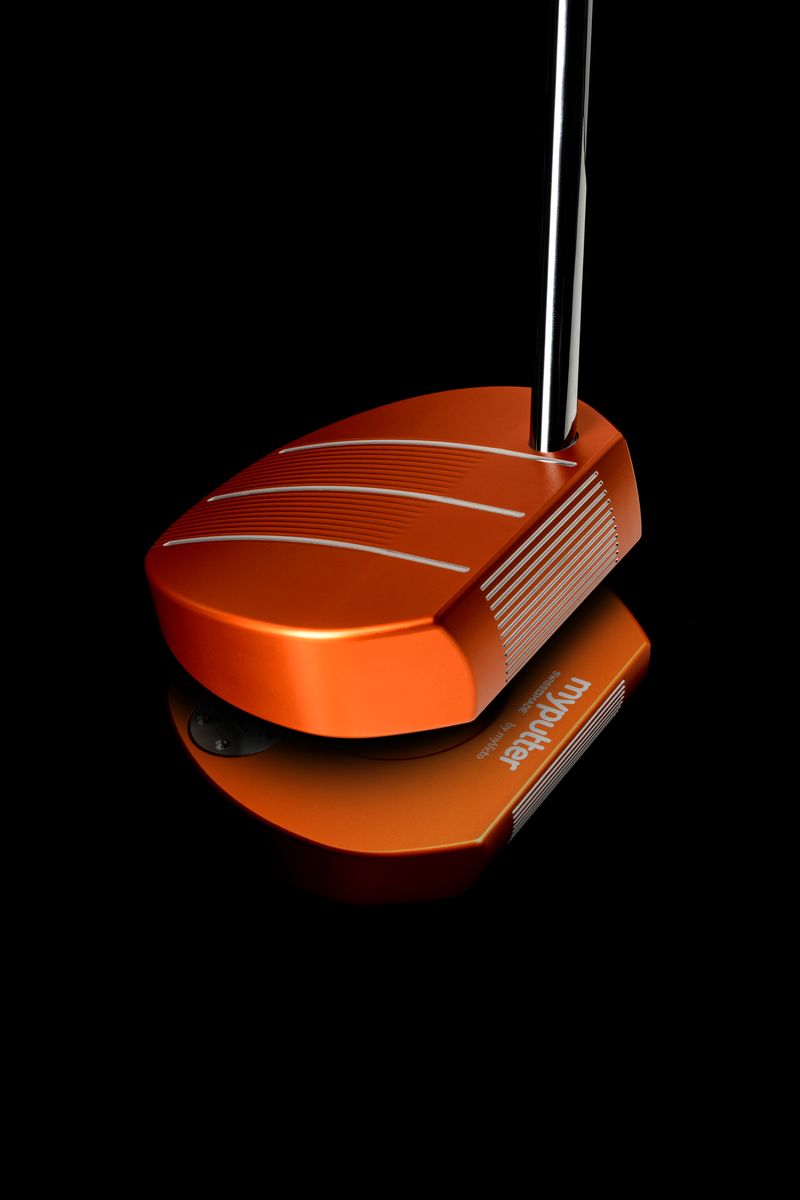
Every myvicto putter is built to custom length. You choose the length during configuration. There is no "standard" option that you hope fits. You specify the number based on your height chart result or your wrist-to-floor measurement.
But custom length is the starting point. What makes the distance consistent is the face.
On the myvicto curved face, loft varies continuously from the bottom to the top of the face. When your hands press forward, the face tilts forward and loses loft, and the ball meets a part of the curve that has more loft. When your hands hang back, the face gains loft, and the ball meets a part of the curve with less loft. So the loft at impact changes much less than on a flat face.
Length and loft work together. The correct length gives you the right posture and eye position. The curved face makes the loft at impact much less sensitive to where your hands sit. One solves the setup. The other solves the contact.
Three things happen with the curved face:
- Loft adapts to hand position. Your hands shift. The face compensates. Launch is more consistent from putt to putt.
- Contact happens at the equator. The ball leaves the face on a flatter line, so the skid is shorter and more consistent. That makes your distance easier to control.
- The vertical sweet spot is three to six times larger. From 1-2mm on a flat face to approximately 6mm.
The curved face works exclusively on the vertical axis: distance consistency. Direction remains the golfer's responsibility: stroke path, face angle, and alignment.
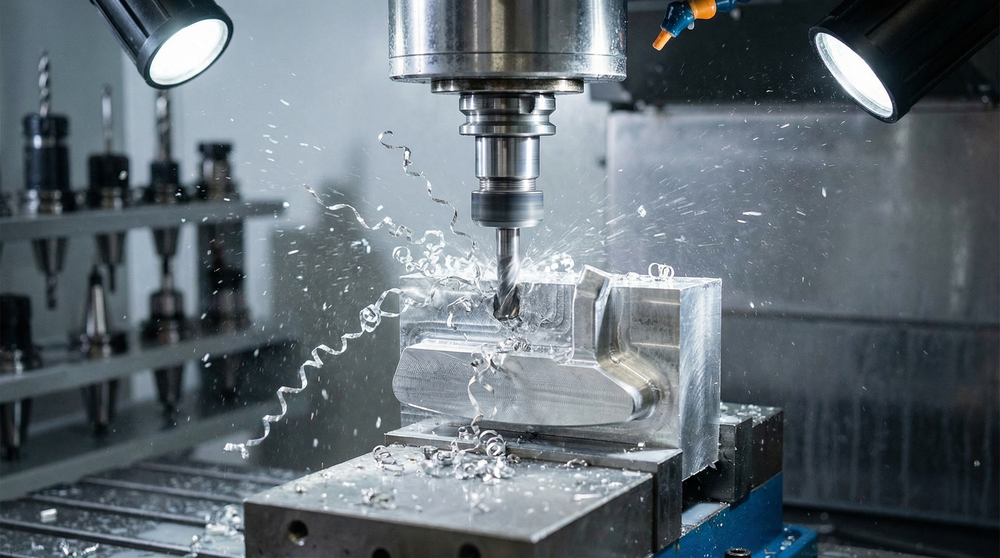
Every model is CNC-milled from 6061 aluminium in a Swiss workshop. Six head shapes, each named after a dam, five of them in Switzerland. Blade, mid-mallet, and mallet options to match your stroke type. Custom length, lie, and grip configured online. See how the curved face works.

Frequently Asked Questions
What is the standard putter length?
The most common standard putter length is 34 inches. Most off-the-rack putters come in 33, 34, or 35 inches. The 34-inch option fits golfers roughly 5 feet 8 inches to 5 feet 11 inches tall. Shorter golfers usually need less than 34 inches, and taller golfers usually need more than 34 inches.
How do I know if my putter is the right length?
Address a ball in your natural putting stance. Your arms should hang relaxed under your shoulders with a slight elbow bend. Your eyes should sit directly over the ball or slightly inside the target line. If your elbows are cramped or your back is strained, the length is wrong. The sole of the putter should sit flat on the ground without the toe or heel lifting.
Does putter length affect distance control?
Indirectly, yes. The wrong putter length creates tension in your posture, which disrupts tempo. Smooth tempo is the foundation of speed control. However, putter length primarily affects aim and posture. Distance consistency is more directly affected by loft variation at impact, which is a face variable rather than a length variable.
Should I cut down a putter that is too long?
You can, but be aware that shortening a putter changes the swing weight. Cutting half an inch off the shaft makes the head feel lighter relative to the grip. This can change your tempo and distance control. If you cut more than an inch, you may need to add head weight to restore the original swing weight. A club fitter can advise on the right counterbalance.
What length putter do most pros use?
Most PGA Tour professionals use putters between 33 and 35 inches. But tour players are fitted precisely. They do not use off-the-rack lengths. Their putter length matches their exact posture, arm length, and eye position. The lesson is not "use 34 inches." It is "get measured for your length."
Is wrist-to-floor or height more accurate for putter length?
Wrist-to-floor is more accurate. Two golfers who are both 6 feet tall can have significantly different arm lengths. The golfer with longer arms needs a shorter putter despite being the same height. Height gives you a range. Wrist-to-floor gives you a number. Method 1 above shows how to turn that number into a putter length.
Related guides
- Putter Fitting Guide: Is Custom Fitting Worth It?
- How to Choose a Putter: The Complete Guide
- Putter Loft Explained: Why It Matters More Than You Think
- How the Curved Face Works
- Free Putter Fitting Experience