Putter Fitting Guide: Is Custom Fitting Worth It? (2026)
Yes, putter fitting is worth it. Research shows that distance control accounts for 80% of putting performance, and a properly fitted putter improves distance consistency by reducing the variables that cause three-putts. The real question is not whether to get fitted. It is whether the fitting measures everything that matters.
What Happens During a Putter Fitting?
A putter fitting is a structured session where a trained fitter analyzes your putting stroke, your body measurements, and your preferences to determine the putter specifications that match you. It is not a sales pitch. It is a measurement process.
Most fittings last 45 to 90 minutes. You arrive, warm up with a few putts, and the fitter begins collecting data. Some facilities use SAM PuttLab or Quintic Ball Roll systems to track your stroke path, face angle at impact, and ball roll characteristics. Others use simpler tools: tape on the sole, a lie board, and a trained eye.
The session typically follows this sequence:
- Stroke analysis. The fitter watches you putt. They identify your stroke type (arc, slight arc, or straight). This determines the head shape and toe hang category.
- Static measurements. Your height, wrist-to-floor distance, arm length, and natural posture. These determine starting values for length and lie.
- Dynamic testing. You putt with different configurations. The fitter adjusts length, lie, loft, and head weight in real time. You see the results on a monitor or through ball tracking.
- Head selection. Blade, mid-mallet, or mallet. Based on your stroke type and visual preference at address.
- Grip and alignment. Grip size, shape, and alignment aids that suit your hand size and setup.
- Final spec sheet. You leave with a complete specification: length, lie, loft, head model, grip, and weight.
The quality of a fitting depends entirely on the fitter. A good fitter explains what they measure and why. A great fitter shows you the difference each adjustment makes on the ball roll data. If you leave a fitting without understanding why each spec was chosen, the fitting was incomplete.
What Gets Measured: The Six Variables
Every putter fitting measures the same core variables. Understanding what each one does helps you evaluate the fitting and your current setup.
1. Length
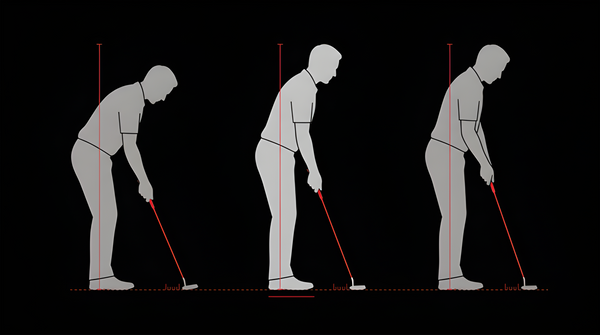
Length determines your posture and eye position over the ball. Standard putters measure 33 to 35 inches. The correct length lets your arms hang naturally under your shoulders with your eyes directly over or slightly inside the ball. Too long and your eyes drift inside the line. Too short and you crouch, straining your back. The GolfWorks recommends measuring from wrist to floor in your putting stance as the baseline. Read our full guide on measuring putter length.
2. Lie angle
Lie angle is the angle between the shaft and the sole of the putter. It determines whether the sole sits flat on the ground at address. If the toe is up, the lie is too upright and you will pull putts left. If the heel is up, the lie is too flat and you will push putts right. Even 2 degrees off can cause a 28-foot putt to miss by nearly two inches. The United States Golf Teachers Federation considers lie angle the most overlooked fitting variable.
3. Loft
Putter loft typically ranges from 2 to 4 degrees. The purpose of loft is to lift the ball out of the slight depression it sits in on the green and launch it onto the surface for a clean roll. Too much loft and the ball pops up and skids. Too little and it drives into the turf and bounces. True Spec Golf recommends approximately 3.5 degrees as a starting point, adjusted based on your hand position at impact. Learn more about how putter loft affects your roll.
4. Head weight
Standard putter head weight is approximately 350 grams. Heavier heads reduce stroke path deviations and promote a more pendulum-like motion. Lighter heads give more feel and feedback. The GolfWorks fitting protocol tests both lighter and heavier options because head weight affects how a player squares the face at impact. Swing weight (the ratio of head weight to total weight) matters as much as the raw number.
5. Grip size and style
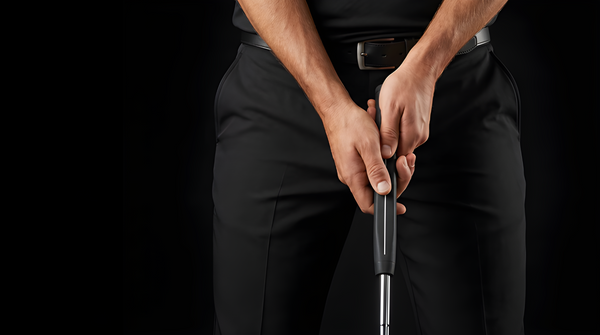
Grip diameter affects wrist action. Smaller grips promote a flowing, arcing stroke with more wrist involvement. Larger grips quiet the wrists and promote a shoulder-driven stroke. Pistol grips suit traditional strokes. Paddle grips suit players who want less hand rotation. The grip must match the stroke type, not just the hand size. For the full breakdown of grip sizes and styles, see our putter grip guide.
6. Head shape and toe hang
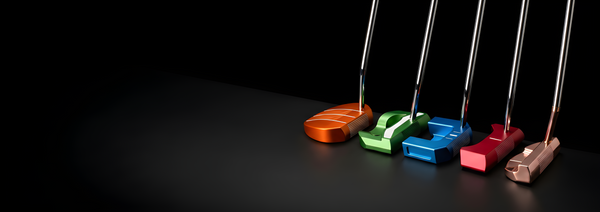
The head shape and hosel determine the toe hang, which must match your stroke type. Blades with plumber's necks suit moderate to strong arcs. Mid-mallets with flow necks suit slight arcs. Face-balanced mallets suit straight strokes. PING fitting data shows that 55% of golfers arrive with a putter that does not match their stroke type. See our complete putter selection guide.
Already know your specs but want to see how they work with a curved face? Start with our fitting experience.
DIY Fitting: How to Check Your Own Setup
Not everyone can visit a fitter. These four tests let you evaluate your current putter at home. You need a flat putting surface, some tape, and a friend with a phone camera.
Test 1: Length check
Stand naturally in your putting posture. Let your arms hang straight down from your shoulders. Your hands should reach the grip without reaching or cramping your elbows. Have someone photograph your setup from the side. Look at your arm angle. If your elbows are bent sharply inward, the putter is too long. If your arms are extended and tense, it is too short.
Test 2: Lie angle check
Place a strip of masking tape along the bottom of your putter sole. Hit 10 putts on a firm, flat surface. Examine the wear marks. If the marks concentrate toward the toe, the lie angle is too flat. If they concentrate toward the heel, it is too upright. Centered marks mean the sole is sitting correctly.
Test 3: Eye position check
Address a ball. Hold a second ball at the bridge of your nose and drop it. Where it lands tells you where your eyes are relative to the ball on the ground. Directly on top of the ball or slightly inside the target line is correct. Well inside or outside means your length or posture needs adjustment.
Test 4: Distance consistency check
Hit 10 putts from 20 feet with the same tempo. Measure the spread between the shortest and longest putt. If the spread exceeds 4 feet, something in your setup is amplifying distance variation. It could be the putter. It could be the stroke. But it is worth investigating.
When to Get Fitted: 5 Signs You Need It
Not every golfer needs a professional fitting immediately. But these signs indicate that your current putter may not match your game.
- You three-putt more than twice per round. Three-putting is primarily a distance control issue. Data from Shot Scope shows that poor distance control causes more three-putts than poor aim. If you are regularly leaving putts 4 or more feet short or long, the putter may be part of the problem.
- You miss short putts to the same side consistently. A repeated miss direction on 3 to 6-foot putts often signals a lie angle mismatch. If you consistently pull or push short putts, check the lie before blaming the stroke.
- You have never been fitted. If you bought your putter off the rack, it was built to standard specs that fit a hypothetical average golfer. The odds that those specs match your body and stroke are low.
- Your putter is more than 5 years old. Your body changes. Your stroke evolves. The putter that worked five years ago may not work today. A fitting recalibrates the specs to your current game.
- You changed your putting stroke. If you moved from an arc to a straight stroke (or vice versa) after lessons, the head shape and toe hang need to change with it. The old putter is now fighting the new stroke.
Putter Fitting Cost: What to Expect
Putter fitting costs vary based on the facility, the technology used, and whether the fitting fee applies toward a purchase.
| Fitting Type | Typical Cost (USD) | What You Get |
|---|---|---|
| Big-box retailer (Golf Galaxy, PGA Superstore) | Free to $50 | Basic stroke analysis, limited head options, spec sheet |
| Independent club fitter | $75 to $150 | Full analysis, SAM PuttLab or Quintic data, broad head selection |
| Premium studio (Club Champion, True Spec) | $100 to $175 | Tour-level technology, extensive inventory, detailed spec report |
| Brand-specific (Bettinardi Studio B, Scotty Cameron) | $100 to $200 | Full fitting within one brand's lineup, often credited toward purchase |
Many fitters credit the fitting fee toward a putter purchase. Bettinardi charges $100 for a studio fitting with the fee applied to any production putter. Club Champion's comprehensive fitting includes putter as part of their full bag experience.
The cost is not the question. A putter fitting costs less than a sleeve of premium balls per round for a year. The question is whether the fitting measures everything that affects your distance control. Most do not.
The Variable Most Fitters Miss
A standard putter fitting measures six variables. Length, lie, loft, weight, grip, head shape. Every one of those matters. Getting them right puts you in a putter that fits your body and your stroke.
But there is a seventh variable that 99% of fittings never address.
The face.
Every putter in a fitting studio has a flat face. The fitter optimizes everything around a face that cannot adapt.
Here is the problem. A flat face has one loft angle. That loft works perfectly when your hands are in the exact position the designer intended. But your hands are never in the same position twice. Fitting data from True Spec and the USGTF confirms that even well-fitted golfers show 2 to 4 degrees of effective loft variation from stroke to stroke, caused by small shifts in hand position at impact.
Those shifts change the launch. They change the skid distance. They change where the ball stops.
A fitter can set your loft to the optimal 3.5 degrees. That number is correct for one hand position. On the next putt, your hands shift 3mm forward. The effective loft drops to 2 degrees. The ball drives into the turf. On the putt after that, your hands hang back slightly. The loft jumps to 5 degrees. The ball pops and skids.
Same fitted putter. Same fitted loft. Three different distances.
The fitting was not wrong. It was incomplete. It optimized six variables around a seventh one (the face) that has a built-in limitation no amount of fitting can solve.
Want a fitting that covers all the variables?
Answer a few quick questions about your stroke and the miss that bugs you most. We'll match you to the putter built for your game.
Take the quizA Fitting That Covers Everything
Myvicto's fitting experience is remote. You do not need to visit a studio. You send three video clips of your putting stroke. The team analyzes your arc, your posture, your hand position patterns, and your distance consistency. They recommend the model, length, lie, loft, and grip that fit your game.
But the fitting goes one step further. It also addresses the face.
Every myvicto putter has a curved face. The face is convex. Loft varies continuously from the bottom to the top of the face. When your hands press forward, you strike higher on the face where there is more loft. The extra loft compensates. When your hands hang back, you strike lower where there is less loft. The reduced loft compensates.
The result: consistent launch angle regardless of where your hands sit at impact.
Three things happen simultaneously with the curved face:
- Loft adapts to hand position. Your hands shift. The face compensates. The launch stays consistent from putt to putt.
- Contact happens above the equator. The curved geometry ensures the ball is always struck just above the equator. That produces immediate forward spin. Skid is reduced. The ball gets into true roll faster.
- The vertical sweet spot is three to six times larger. From 1-2mm on a flat face to approximately 6mm. The impact factor stays at 1.60 to 1.62 across the entire ellipse. Same energy transfer whether you strike it perfectly or miss by a few millimeters vertically.
A 15-handicap golfer hits the sweet spot roughly 75 out of 100 putts. Even tour professionals miss it about 5 times in 100. A larger vertical sweet spot means more of those putts transfer the energy you intended. Distance becomes predictable.
Every model is CNC-milled from 6061 aluminium in a Swiss workshop. Custom length, lie, and grip are configured online. The curved face is the same across every model. See how the curved face works.

Frequently Asked Questions
Is putter fitting worth it for high handicappers?
Yes. High handicappers benefit more from putter fitting than low handicappers because they have more room for improvement. Three-putting is predominantly a distance control issue, and a properly fitted putter reduces the setup variables that cause distance inconsistency. Getting the length and lie angle correct alone can eliminate strokes that have nothing to do with skill.
How much does a putter fitting cost?
Typical putter fitting costs range from free (at big-box retailers) to $175 at premium studios like Club Champion or True Spec. Most facilities credit the fitting fee toward a putter purchase. Independent fitters generally charge $75 to $150. The cost varies based on technology used, location, and the breadth of putter inventory available during the session.
Can I get fitted for a putter online?
Yes. Remote putter fitting has become more accessible. You record your putting stroke on video and send the clips to the fitting team. They analyze your stroke type, posture, and hand position patterns. The trade-off is that remote fittings cannot measure lie angle impact marks in real time. The advantage is access to fitting expertise without geographic limitations. Try our remote fitting experience.
How often should I get my putter fitted?
Every 3 to 5 years, or whenever your putting stroke changes significantly. If you take lessons that alter your posture or stroke mechanics, a re-fitting is worth considering. Your body changes over time. The specs that worked at 30 may not suit you at 45. There is no expiration date, but there is no lifetime guarantee either.
What is the most important putter fitting variable?
Length. It determines your posture, eye position, and arm hang. If the length is wrong, every other variable is compensating for a bad foundation. Lie angle is a close second. After that, head shape and toe hang matching. Most fitters agree that these three cover 80% of the fitting benefit.
Does putter fitting help with distance control?
A properly fitted putter improves distance control by ensuring consistent contact, correct launch conditions, and appropriate energy transfer. Research from Dr. Paul Hurrion shows that distance control accounts for 80% of putting performance. However, standard fittings optimize around a flat face with fixed loft. The face itself remains a variable that only a curved face can address.
Related guides
- How to Measure Putter Length: Height Chart + Fitting Guide
- How to Choose a Putter: The Complete Guide
- Putter Loft Explained: Why It Matters More Than You Think
- How the Curved Face Works
- Free Putter Fitting Experience
- Browse the Full Collection