How to Choose a Putter: The Only Guide You Need (2026)
To choose a putter, start with head shape (blade, mallet, or mid-mallet), then match toe hang to your stroke type (arc or straight). Get the length, lie, and loft fitted to your setup. Then look at the face. Flat or curved, this is where distance consistency is decided. Most guides never get there.
How to Choose a Putter: The Key Factors
Putting accounts for roughly 40% of all strokes in a round of golf. Yet most golfers spend less time choosing their putter than they do choosing a driver. The result: a putter that works against them on every green, every round, for years.
Choosing the right putter comes down to six factors. Each one narrows the field. Get them in order and the decision becomes obvious.
- Head shape determines forgiveness, feel, and alignment.
- Stroke type and toe hang determine whether the putter moves with your stroke or fights it.
- Length, lie, and loft determine posture, aim, and launch.
- Hosel type and offset determine how much toe hang you get and where your eyes line up at address.
- Weight, grip, and feel determine tempo, wrist involvement, and confidence.
- The face determines distance consistency. This is the factor most guides skip entirely.
The rest of this guide covers each one. No filler. No "it depends on personal preference" without telling you what to look for. By the end, you will know exactly what putter specs match your game.
Head Shape: Blade vs Mallet vs Mid-Mallet
Head shape is the first decision because it affects everything else: weight distribution, alignment, feel, and which stroke types the putter supports.
Blade putters
Blades are compact, thin, heel-weighted. The classic putter shape. They provide more feel and feedback at impact than any other design. When you catch the center, you know it. When you miss, you know that too.
Blades are naturally suited for arc strokes. The heel weighting produces toe hang, which lets the face open and close in time with a curved stroke path. On Tour, blade putters remain the most popular choice. The Scotty Cameron Newport and PING Anser shapes have won more events than any other putter design in history.
The trade-off: smaller sweet spot. A blade is less forgiving on off-center hits than a mallet. The moment of inertia (MOI) is lower, so mishits lose more speed and roll out less predictably.
Best for: Golfers who prioritize feel and feedback. Arc stroke players. Players with consistent, repeatable strokes who want to know exactly where they struck the ball. Full blade vs mallet comparison here.
Mallet putters
Mallets have larger, deeper heads. More mass is distributed around the perimeter, which raises the MOI. Higher MOI means more forgiveness. Off-center hits retain more speed and hold their line better than on a blade.
Most mallets are face-balanced. The weight is evenly distributed so the face points straight up when you balance the shaft on your finger. This makes them ideal for straight-back, straight-through (SBST) strokes. The putter resists rotation. It wants to stay square. For a SBST player, that is exactly what you want.
Mallets also tend to have more alignment aids. Lines, dots, contrasting colors on the flange. For golfers who struggle with aim, a mallet gives more visual cues at address.
Best for: SBST stroke players. Golfers who want maximum forgiveness on mishits. Players who benefit from visual alignment aids.
Mid-mallet putters
The mid-mallet sits between a blade and a full mallet. Bigger than a blade. Smaller than a mallet. It offers more forgiveness than a blade while still allowing some natural toe flow for players with a slight arc.
Mid-mallets have grown in popularity over the past five years. They suit the most common stroke type in amateur golf: the slight arc. You get higher MOI than a blade without the fully face-balanced feel of a large mallet.
Best for: Slight arc players who want more forgiveness. Golfers transitioning from a blade who want stability without losing all feedback.
Quick comparison
| Factor | Blade | Mid-Mallet | Mallet |
|---|---|---|---|
| Feel / feedback | Highest | Moderate | Lower |
| Forgiveness (MOI) | Lowest | Moderate | Highest |
| Typical balance | Toe hang | Moderate toe hang | Face balanced |
| Best stroke type | Moderate to strong arc | Slight arc | SBST (straight) |
| Alignment aids | Minimal | Moderate | Maximum |
Choose the head shape that matches your stroke and your forgiveness needs. Then move to the next filter.
Stroke Type and Toe Hang
Your stroke type is the most important variable in putter selection. Get it wrong and the putter fights you on every putt. Get it right and the putter moves with your natural motion.
The two stroke types
Arc stroke: The putter head moves inside the target line on the backswing, returns to square at impact, and moves inside again on the follow-through. The face opens slightly going back and closes slightly going through. Over 70% of golfers have some degree of arc in their stroke. This is the natural result of the putter's 70-degree lie angle. Full arc stroke putter guide here.
Straight-back, straight-through (SBST): The putter head moves along the target line with minimal face rotation. Less common than most golfers think. True SBST players are a minority.
How to test your stroke
Two methods. First: place your phone on the ground behind you, aimed at the putter head. Hit five putts at a target 10 feet away. If the head swings inside the target line on both backswing and follow-through, you have an arc.
Second: balance your putter shaft on your index finger. If the face points at the sky, it is face-balanced. If the toe drops toward the ground, the putter has toe hang. Now compare: if your stroke arcs and your putter is face-balanced, they are working against each other.
Matching toe hang to stroke
Toe hang is the angle at which the putter toe points downward when you balance the shaft on your finger. Hireko Golf's fitting research calls it the only putter specification that directly relates to stroke type.
| Stroke Type | Toe Hang Needed | Angle (approx.) | Typical Head |
|---|---|---|---|
| SBST (straight) | Face balanced | 0 degrees | Full mallet, center shaft |
| Very slight arc | Quarter hang | ~20 degrees | Mid-mallet, short slant |
| Slight to moderate arc | Half hang | ~45 degrees | Mid-mallet, flow neck blade |
| Moderate to strong arc | Three-quarter hang | ~60 degrees | Blade, plumber's neck |
| Strong arc | Full hang | ~90 degrees | Blade, heel shaft |
PING fitting data shows that 55% of golfers arrive with face-balanced putters designed for straight strokes. But the majority of those golfers actually have an arc. They are fighting their putter on every putt and do not know it.
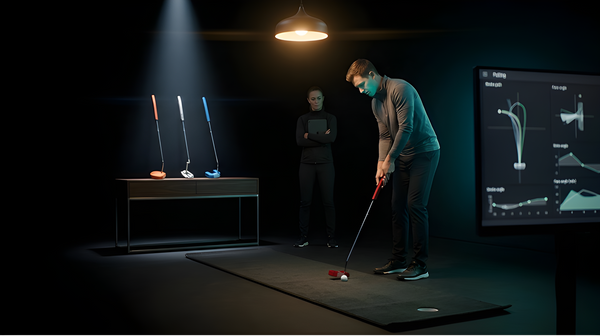
Not sure about your stroke type? Our fitting experience analyzes your stroke from video and matches you to the right toe hang and head shape.
Length, Lie, and Loft: The Fitting Basics
Head shape and toe hang get you to the right putter family. Length, lie, and loft fine-tune it to your body and your setup.
Length
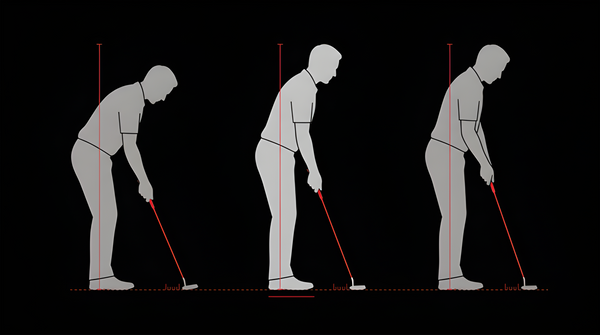
Putter length is the most important fitting variable according to the USGTF, because it dictates posture, eye position, arm hang, and the entire geometry of your stroke. Standard men's putters run 33 to 35 inches. Standard women's putters run 32 to 34 inches. But "standard" may not be right for you.
The test: set up in your natural putting posture. Arms hanging relaxed, eyes over or just inside the ball. Have someone measure from your wrist crease to the ground. That measurement, combined with your posture preference, gives you the right length.
Too long and you stand too upright. Your eyes move outside the ball. The toe lifts off the ground. Too short and you hunch over. Your arms tense. The heel lifts. Both create aim errors before you even start the stroke.
Lie angle
Lie angle is the angle between the shaft and the sole. Standard is around 70 degrees. When the lie angle is correct, the sole sits flat on the green at address. The sweet spot contacts the ball cleanly.
When the lie is off, the toe or heel lifts. Because the putter has loft, a mis-fitted lie angle sends the ball offline. The putter face can be perfectly square and the ball still starts left or right because the toe or heel is off the ground. This is one of the most overlooked causes of missed putts.
Loft
Standard putter loft sits between 2 and 4 degrees. Most stock putters ship at 3 to 3.5 degrees. This loft is designed to lift the ball up and onto the green surface for a smooth roll.
Too little loft and the ball drives into the turf, bounces, and skids unpredictably. Too much loft and the ball pops up, lands, and skids before it starts rolling. Both destroy distance control.
Here is the part most guides gloss over: loft is designed for one specific hand position at impact. The hand position the designer assumed you would use. If your hands press forward at impact, you de-loft the face. If your hands sit back, you add loft. The effective loft changes with every putt depending on where your hands are at the moment of contact.
We will come back to this. It matters more than most golfers realize.
Hosel Type and Offset
The hosel is the connection point between the shaft and the putter head. It determines toe hang, offset, and how the putter looks at address. Same head, different hosel, completely different balance.
Hosel types
- Plumber's neck: The most common hosel in golf. An L-shaped bend that creates moderate to strong toe hang and full shaft offset. Works for slight through strong arc strokes depending on the head. If you do not know where to start, start here.
- Flow neck (gooseneck): A smooth, curved transition from shaft to head. Moderate toe hang with less offset than a plumber's neck. Clean look at address. Good for slight arc players who prefer a less technical setup.
- Heel shaft: The shaft connects directly at the heel. Maximum toe hang. Full rotation. Strong arc territory. Gives the head the most freedom to open and close through the stroke.
- Short slant: The shaft meets the head at a slight angle. Low to moderate toe hang. A versatile option that works for very slight arcs or as a bridge from face-balanced putters.
- Double bend: Two bends in the shaft push the connection point toward center. Typically face-balanced. Designed for SBST strokes.
- Center shaft: Straight shaft into the middle of the head. Maximum face balance. SBST only. Not suited for any arc.
For a deeper look at how hosel type interacts with face balance and toe hang, see our face balanced vs toe hang breakdown.
Offset
Offset is how far the putter face sits behind the shaft at address. More offset means your hands are further ahead of the ball. Less offset means the face is closer to the shaft line.
Full shaft offset (common with plumber's neck): a full shaft width ahead of the face. Encourages a slight forward press. Suits golfers who like to see their hands ahead of the ball at address.
Half shaft offset (common with flow neck or short slant): half a shaft width ahead. A more neutral look. Works for players who prefer a squarer setup.
Minimal or no offset (common with center shaft): the face sits directly below the shaft. Designed for SBST players who want the ball positioned directly under the shaft line.
The wrong offset can cause unconscious aim errors. According to Evnroll's fitting data, different offset styles cause golfers to aim slightly left or right without realizing it. If you consistently miss in one direction despite a square face, the offset may be the issue.
Weight, Grip, and Feel
These three specifications shape the sensation of putting. They do not change the physics as much as head shape or toe hang, but they affect tempo, confidence, and consistency.
Head weight
Most premium putters sit between 340 and 360 grams of head weight. Heavier heads produce a more pendulum-like stroke with less hand involvement. Lighter heads give more feel and touch.
EMG research found that a 350g head weight cuts stroke path deviations by 19% compared to lighter alternatives. For golfers who struggle with tempo or tend to get wristy under pressure, a heavier head helps.
A general rule from club fitters: heavier heads work better on slow greens where you need to generate momentum. Lighter heads work better on fast greens where touch and deceleration control matter.
Grip
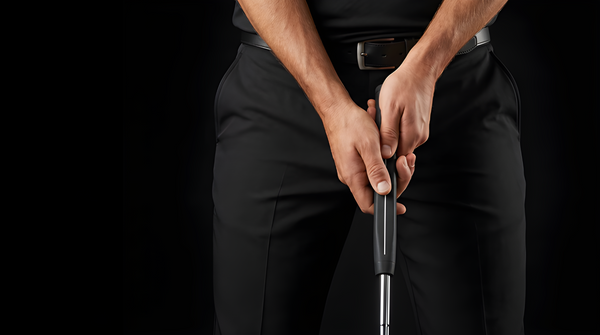
Grip size directly affects wrist involvement. A larger grip reduces wrist action. It promotes an arms-and-shoulders stroke. A smaller grip allows more wrist hinge. More feel, but less consistency under pressure.
The SuperStroke fitting philosophy pairs larger grips with face-balanced putters and SBST strokes. Smaller, traditional grips pair with toe-hang putters and arc strokes. The logic: an arc stroke needs some wrist flow, and a smaller grip allows it.
Grip weight matters too. A lighter grip makes the head feel heavier (more pendulum effect). A heavier grip makes the head feel lighter (more hand control). The balance between grip weight and head weight sets the swing weight, which determines how the putter feels in motion.
For a full guide on grip technique and how it interacts with your putter choice, see how to grip a putter.
Feel
Feel is subjective, but it comes from materials and milling. CNC-milled stainless steel provides a firm, crisp response at impact. Insert faces (polymer or aluminium inserts) feel softer and deaden vibration.
Neither is better. It is a preference. But your feel preference should match your playing conditions. Firm feel gives more feedback on fast, firm greens. Soft feel reduces the harshness on slower, rougher surfaces.
The one constant: a putter you do not enjoy putting with is a putter you will never trust. And trust is everything on the greens.
The Factor Most Putter Guides Skip
You have the head shape. You have matched the toe hang to your stroke. The length, lie, and loft are dialled in. The hosel suits your arc. The weight and grip feel right in your hands.
But there is one more factor that most guides skip entirely: the face.
Every putter on the market has a flat face. One fixed loft angle. Designed for one hand position at impact. And your hands are never in the same position twice.
This is not opinion. It is biomechanics. Under pressure, you press forward. On fast greens, you hang back. On the 18th with the match on the line, your hands do something slightly different than they did on the practice green. Every shift changes the effective loft at impact.
Same stroke. Same putter. A few millimeters of hand variation. Two putts stop 3 feet apart.
Press your hands forward and you de-loft the face. The ball drives into the ground, bounces, skids. The distance becomes unpredictable. Let your hands hang back and you add loft. The ball pops up, skids longer, stops short.
On a 20-foot putt, this hand variation alone can produce 2 to 3 feet of distance spread. Not because you swung differently. Because your hand position shifted a few millimeters and the flat face had no way to adjust.
Toe hang and head shape solve the horizontal axis. Your stroke path. Your face angle at impact. Every other brand works on this. Face balanced vs toe hang is part of this conversation.
But the vertical axis is where distance consistency lives. Loft at impact. Contact point on the face. Energy transfer. And on the vertical axis, every flat face responds the same way to hand variation: inconsistently.
You got five out of six factors right. The sixth one is where distance is won or lost.
Not sure which putter matches your game?
Answer a few quick questions about your stroke and the miss that bugs you most. We'll match you to the putter built for your game.
Take the quizThe Curved Face: The Missing Piece in Putter Selection
A curved face is convex. The loft varies continuously from the bottom of the face to the top. There is no single fixed loft angle. Instead, the face provides a gradient: less loft at the bottom, more at the top.
When your hands press forward, you strike the ball higher on the face where there is more loft. The extra loft compensates for the de-lofting your hand position created. When your hands hang back, you strike lower on the face where there is less loft. The reduced loft compensates for the extra loft your hand position added.
The launch angle stays consistent. The ball speed stays consistent. The distance stays consistent. Regardless of where your hands sit at impact.
Three things happen simultaneously with a curved face:
- Loft adapts to hand position. Your hands shift. The face compensates. The launch stays consistent regardless of where your hands sit at the moment of contact.
- The ball contacts above the equator. The curved geometry ensures contact above the ball's center line. That produces immediate forward spin. Skid is reduced. The ball gets into true roll faster and holds its line better.
- The vertical sweet spot expands. From 1-2mm on a flat face to approximately 6mm. The impact factor stays at 1.60 to 1.62 across the entire sweet spot ellipse. Same energy transfer whether you catch it perfectly or miss by a few millimeters vertically.
A 15-handicap golfer hits the sweet spot roughly 75 out of 100 putts. Even tour professionals miss it about 5 times in 100. A vertical sweet spot three to six times taller means more of those putts transfer the energy you intended. See how the curved face works.
Matching myvicto models to your stroke
Every myvicto putter shares the same curved face. The difference is the head shape and toe hang. Choose the model that matches your stroke type.
| Stroke Type | Model | Head Shape | Toe Hang |
|---|---|---|---|
| Strong arc | B-Series | Blade | Full (heel shaft) |
| Slight arc | E-Series | Mid-mallet | Moderate (flow neck) |
| SBST (straight) | Z-Series | Mallet | Face balanced |


The B-Series is for golfers whose stroke arcs 4 or more inches inside the target line. Full toe hang. Compact blade head. Maximum feel. The curved face matters most here because a strong arc creates the most hand position variation at impact.
The E-Series suits the most common stroke in amateur golf: the slight arc. Moderate toe hang from a flow neck hosel. Higher MOI than a blade for horizontal forgiveness. The curved face adds vertical forgiveness that no flat-faced mid-mallet can match.
The Z-Series is for true SBST players. Face balanced. High MOI mallet head. The curved face still compensates for the loft variation that even straight stroke players create through hand position changes.
All three are CNC-milled from 6061 aluminium in a Swiss workshop. Same curved face. Same 6mm vertical sweet spot. Same constant impact factor. The head shape and hosel match your stroke. The face handles the rest. Browse the full collection.
Find Your Putter
Choosing a putter is a sequence, not a guess.
Step one: head shape. Blade for feel and arc strokes. Mallet for forgiveness and straight strokes. Mid-mallet if you want the middle ground.
Step two: stroke type and toe hang. Match the toe hang to your arc. This is the single biggest improvement most golfers can make.
Step three: length, lie, and loft. Get fitted. The stock specs may not be right for your setup.
Step four: hosel, offset, weight, and grip. Dial in the details that affect aim, tempo, and feel.
Step five: the face. A flat face gives you one loft for one hand position. A curved face adapts to the hand position you actually deliver. This is where distance consistency separates from distance hope.
Most golfers get steps one through four right and never realize step five exists.
Find Which Putter Fits Your Game
Answer a few quick questions about your stroke and the miss that bugs you most. We'll match you to the putter built for your game.
Take the quizFrequently Asked Questions
How do I know what putter is right for me?
Start with your stroke type. Film your stroke from behind and check whether the putter head arcs inside the target line or stays straight. Then match a head shape and toe hang to that stroke. Get fitted for length and lie. Finally, consider the face type. A flat face gives you one fixed loft. A curved face adapts loft to your hand position at impact for more consistent distance.
What putter head shape should a beginner choose?
A mid-mallet with moderate toe hang is the safest starting point for beginners. It provides more forgiveness than a blade and works with the most common stroke type (slight arc). The larger head offers better alignment cues. As your stroke becomes more consistent, you can move to a blade if you want more feel.
What is the difference between a blade and a mallet putter?
Blades are compact, heel-weighted, and provide more feedback at impact. They naturally produce toe hang and suit arc strokes. Mallets are larger, perimeter-weighted, and more forgiving on mishits. Most mallets are face-balanced and suit straight strokes. The choice depends on your stroke type and how much forgiveness you need. Read the full comparison.
Does putter length really matter?
Yes. Length determines your posture, eye position, and arm hang. Too long and you stand upright with eyes outside the ball. Too short and you hunch over with tense arms. Both create aim errors before the stroke starts. Standard lengths are 33 to 35 inches for men and 32 to 34 for women, but getting fitted for your body and posture is worth the effort. Full length guide here.
What does toe hang mean on a putter?
Toe hang is the angle at which the putter toe drops toward the ground when you balance the shaft on your finger. More toe hang means the putter naturally wants to open and close through the stroke, which matches an arc. Face-balanced putters (zero toe hang) resist rotation and suit straight strokes. Full toe hang explanation here.
Should I get fitted for a putter?
Yes. Putting accounts for roughly 40% of your strokes. A putter that does not match your stroke type, body measurements, and setup costs you putts every round. At minimum, match your toe hang to your stroke and get the length right. A full fitting covers lie angle, loft, grip size, and head weight. The difference between a fitted and unfitted putter is measurable from the first round.
What is the most forgiving putter style?
High-MOI mallets with perimeter weighting are the most forgiving on off-center hits. The larger head distributes mass around the edges, so mishits retain more speed and hold their line. But forgiveness on the horizontal axis (toe-heel) is only part of the equation. The vertical axis, specifically the face, determines whether your distance stays consistent when your hand position varies.
Does the putter face affect distance control?
Significantly. A flat face has one fixed loft, designed for one hand position. Every variation in hand position at impact changes the effective loft, which changes the launch, which changes the distance. A curved face varies loft continuously from bottom to top, compensating for hand position shifts and producing more consistent launch and distance.
Related guides
- Mallet vs Blade Putter: How to Choose the Right One
- Best Putter for Arc Stroke (2026)
- Face Balanced vs Toe Hang: What Your Stroke Needs
- How to Measure Putter Length
- How to Grip a Putter
- Face Balanced vs Toe Hang: What's the Real Difference?
- Free Putter Fitting Experience
- How the Curved Face Works