Most Forgiving Putter 2026: What Every Guide Gets Wrong
The most forgiving putter in 2026 combines high MOI, clear alignment aids, and a face that handles both horizontal and vertical mishits. Most guides focus exclusively on MOI. But inconsistent distance is rarely about toe-and-heel contact. It is about where the ball strikes the face vertically. That problem exists at every level of the game.
What Makes a Putter "Beginner-Friendly"?
A beginner-friendly putter does three things. It aims itself. It forgives mishits. And it rolls the ball predictably.
That sounds simple. But the putter market has 400+ models on shelves at any given time. Each claims some version of forgiveness. The difference between a putter that actually helps a beginner and one that just looks forgiving comes down to four specifications.
1. High MOI (moment of inertia)
MOI measures resistance to twisting. When you hit a putt off-center, the putter head wants to twist. High MOI resists that twisting. The ball still goes roughly where you aimed, even on a mishit.
For beginners, this is the most important number. A putter with low MOI punishes every mistake. A putter with high MOI softens the penalty. You still miss. But the miss costs you less.
2. Clear alignment aids
Alignment lines, dots, or contrasting colors on the top of the putter help you aim. For experienced players, these can be distracting. For beginners, they are essential. Your eye is not trained yet. Alignment aids compensate for that.
3. Face insert that controls speed
Milled stainless steel faces are responsive. Too responsive for beginners. A face insert (urethane, aluminium, or composite) softens impact and produces more consistent ball speeds across the face. You feel less difference between a center strike and an off-center one.
4. Moderate weight (340-360g head)
A putter that is too light is hard to control. A putter that is too heavy is hard to feel. The 340 to 360 gram range gives beginners enough heft for a stable stroke without deadening feedback entirely.
One more variable matters before you even swing: length. Most beginners play a putter that is too long, which raises the eyes off the target line and encourages pulled putts. The fix takes 30 seconds with a proper setup. Before buying anything, read how to measure the correct putter length for your posture.
Head Shape for Beginners
Three head shapes. Each serves a different purpose.
Mallet
Larger head. Weight distributed around the perimeter. Higher MOI. More forgiving on horizontal mishits. Most mallets are face-balanced, which suits a straight-back, straight-through stroke. The bigger footprint behind the ball builds visual confidence at address.
For beginners, the mallet is the default recommendation. More forgiveness. More alignment help. More visual stability.
Mid-mallet
A compromise between blade and full mallet. Moderate MOI. Less visual bulk than a mallet. Works with slight arc strokes. The mid-mallet suits beginners who find full mallets too large but want more forgiveness than a blade offers.
Blade
Compact. Traditional. Maximum feel. Minimum forgiveness. Blades reward precision. They do not tolerate mishits. Unless you have a specific reason (strong arc stroke, aesthetic preference), blades are not the place to start as a beginner.
Full mallet vs blade breakdown here.
Alignment Features That Help
Not all alignment aids are created equal. Clear alignment aids with strong color contrast are widely cited in putter design research as helpful for reducing aim error, especially on putts beyond 10 feet. Even small degrees of aim error translate to inches at the hole over a 15-foot putt.
Single line
One line running from the center of the face toward the back of the putter. Simple. Clean. Points at the target. Works best on mallets with enough surface area for the line to be visible.
Triple Track
Three parallel lines. Popularized by Callaway on their Chrome Soft golf balls and adopted by Odyssey for putters. The three-line system uses Vernier acuity, the human eye's ability to detect misalignment between parallel lines. When the lines on the putter align with the lines on the ball, you know you are aimed correctly.
Two-ball / dot system
Two circles on the top of the putter behind the face. The Odyssey 2-Ball has been the most recognized alignment system in putting for over 20 years. The two circles frame the ball at address, creating a visual train that points at the target. Extremely intuitive for beginners.
Sightline with contrasting color
A white or red line against a dark putter head. The contrast makes the line visible in all lighting conditions. Simple and effective. Many premium putters use this approach.
For beginners: choose the alignment system that your eye locks onto naturally. Test several at a putting green. The one that makes you feel certain about your aim before the stroke is the right one.
Forgiveness: MOI and Sweet Spot
Forgiveness in putting is discussed almost exclusively in horizontal terms. Toe hits. Heel hits. Off-center contact left and right across the face. Every manufacturer markets MOI as the forgiveness metric. And it is. On the horizontal axis.
But the sweet spot has two dimensions. Horizontal and vertical.
Horizontal sweet spot: how far left or right of center you can miss and still get acceptable ball speed. This is where MOI helps. Higher MOI means a wider horizontal sweet spot. Mallet putters excel here.
Vertical sweet spot: how far above or below the intended contact point you can miss and still get consistent launch and roll. This is where most putters are identical. On a flat face, the vertical sweet spot is approximately 1 to 2 millimeters tall. Every flat face. Every brand. Every price point.
We will come back to this.
Top 5 High-Forgiveness Putters (2026)
These are five legitimate high-forgiveness options, particularly well-suited for players developing their stroke. Each one is a good putter. The reviews are honest.
| Putter | Type | Key Feature | Best For | Price |
|---|---|---|---|---|
| Odyssey Ai-ONE 2-Ball | Mallet | AI-designed insert + 2-Ball alignment | Beginners who need alignment help | $299 |
| Cleveland HB SOFT 2 | Mallet | SOFT milling + high MOI at low price | Budget-conscious beginners | $159 |
| PING DS 72 | Mallet | Dual-durometer insert + heavy perimeter weighting | Beginners who want soft feel with stability | $275 |
| TaylorMade Spider Tour X | Mallet | True Path alignment + high MOI | Beginners who will grow into the putter | $349 |
| Cobra 3D Agera | Mallet | 3D-printed lattice + Descending Loft Technology | Beginners who want cutting-edge tech | $349 |
Odyssey Ai-ONE 2-Ball
The 2-Ball alignment system is two decades old and still one of the most effective visual aids in putting. Odyssey updated it with an AI-designed face insert that normalizes ball speed across the hitting area. The artificial intelligence mapped thousands of mishit patterns to optimize the insert topography.
Why it works for beginners: The 2-Ball alignment trains your eye to aim correctly. The Ai-ONE insert forgives horizontal mishits. The combination addresses the two biggest beginner problems: aiming and inconsistent contact.
Honest limitation: The insert feel divides opinion. Some golfers describe it as "clicky" rather than soft. If feel matters to you, test it before buying. The forgiveness gain is real, but it is horizontal only.
Cleveland HB SOFT 2
The best value on this list. Cleveland's SOFT milling process in 304 stainless steel produces a surprisingly smooth feel for a sub-$200 putter. Multiple mallet shapes available, all with decent alignment features. The perimeter weighting pushes MOI higher than you would expect at this price.
Why it works for beginners: If you are unsure whether putting is worth investing in yet, this putter lets you find out without a major financial commitment. Solid build. Good forgiveness. No compromises that would hold you back.
Honest limitation: Lighter head than premium options. Less refined milling. The sound at impact is functional but not premium. You feel the price difference when you compare it side by side with a $350 putter.
PING DS 72
PING's dual-durometer face insert uses two different materials in a single insert. Softer material in the center to control ball speed on pure strikes. Firmer material at the edges to maintain speed on off-center hits. The engineering is thoughtful. PING's quality control remains among the best in the industry.
Why it works for beginners: The dual-durometer insert means your short putts feel soft and controlled while your longer putts maintain speed consistency. For beginners who struggle with distance control, this engineering choice helps both ends of the speed spectrum.
Honest limitation: The look at address is understated. If you want bold alignment lines or a visual system that grabs your eye, other options on this list are more assertive. PING trusts your eye to align with the subtle sightline.
TaylorMade Spider Tour X
The Spider name carries weight. It has been on Tour for years. The Tour X model pushes the weight to the extreme perimeter for maximum MOI. The True Path alignment graphic is a wide visual corridor that guides your eye down the target line. Pure Roll insert reduces skid off the face.
Why it works for beginners: This is a putter you will not outgrow. If your handicap drops from 28 to 12, the Spider Tour X still performs. The investment lasts. Many tour professionals use some version of the Spider, which means you are buying a design validated at the highest level.
Honest limitation: The large head can feel disconnected from the ball. Golfers who prefer to feel the strike may find the Spider too muted. The heavier head weight requires a controlled tempo. Quick, wristy strokes do not suit this putter.
Cobra 3D Agera
Cobra used 3D printing to create an internal lattice structure in the putter head. This moves weight to the perimeter more precisely than traditional casting allows. The result is high MOI in a relatively compact mallet shape. Descending Loft Technology uses four different loft angles across the face height to produce more consistent launch regardless of strike location.
Why it works for beginners: The Descending Loft Technology is specifically designed to help with inconsistent strike height. Four tungsten weights push MOI to the upper range for a mallet this size. The 3D-printed construction is not a gimmick. It is a manufacturing method that allows weight placement impossible with casting.
Honest limitation: The aesthetic is polarizing. The 3D-printed lattice is visible through the sole and will not appeal to traditional-minded golfers. The four descending loft zones are discrete steps, not a continuous gradient. The price matches the Spider Tour X despite Cobra's market positioning as more accessible.
Every putter on this list is a legitimate recommendation. Every one solves horizontal forgiveness well. And every single one defines forgiveness the same way: horizontally only.
Already know which head shape you want? Our complete putter selection guide covers the rest of the decision.
The Factor Most Beginner Guides Miss
Every putter buying guide for beginners defines forgiveness as horizontal. High MOI. Perimeter weighting. Toe and heel stability. Hit it left of center? No problem. Hit it right? The MOI absorbs it.
But beginners miss the sweet spot vertically too.
Even a mid-handicap golfer (around 15) misses the sweet spot on roughly 25 out of 100 putts. A beginner or high-handicapper misses it more often than that. Those missed strikes cost strokes. And most of that miss is vertical.
A high-handicapper striking slightly low on the face launches the ball downward. It bounces. The distance becomes unpredictable. Striking slightly high launches it upward. It skids longer. The distance is wrong again. Not by inches. By feet.
On a flat face, the vertical sweet spot is 1 to 2 millimeters. Every flat face. The $159 Cleveland. The $349 Spider. The $499 Scotty Cameron. On the vertical axis, they are all equally unforgiving.
Most golfers do not have the repeatable stroke mechanics to hit a 1-2mm vertical window consistently on every putt. That is not a criticism. It is physics meeting reality. Vertical forgiveness matters at every level of the game. And no flat-faced putter provides it — at any price.
The five putters above solve the horizontal problem. They do not touch the vertical one.
Not sure where you strike the ball on the face?
Put a piece of impact tape on your putter face. Hit 10 putts. The pattern tells you everything. If the marks scatter vertically, that is distance inconsistency that MOI cannot fix.
Get a Free Stroke AnalysisThe Most Forgiving Putter Face on the Market
A curved face is convex. The loft varies continuously from the bottom to the top. There is no single fixed loft angle. Instead, the face provides a gradient that adapts to where the ball is struck vertically.
Strike low on the face: less loft. Strike high: more loft. The launch stays consistent regardless of vertical contact point. For any golfer whose strike height varies putt to putt — which is every golfer to some degree — this means predictable distance even when the contact is not perfect.
Three things happen simultaneously:
- Loft adapts to hand position. Beginners have more hand variation at impact than experienced players. The curved face compensates. Press forward, you strike higher where there is more loft. Hands back, you strike lower where there is less. Launch stays consistent.
- Contact stays above the equator. The curved geometry ensures the ball is always struck just above the equator. Never at it. Never below. That produces immediate forward spin. Skid is reduced. The ball gets into true roll faster and holds its line better.
- The vertical sweet spot expands. From 1-2mm to 6mm, across a horizontal band of roughly 1.5cm each side. Consistent energy transfer whether the strike is perfect or off by a few millimeters.
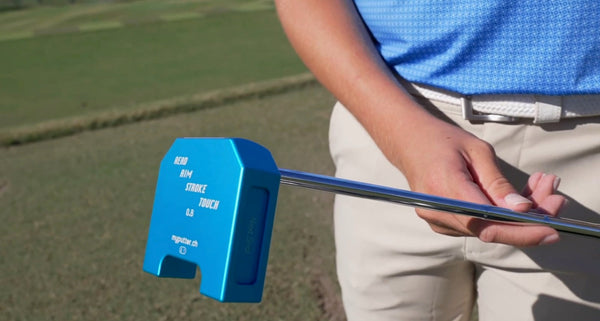
Myvicto is not a budget option. It sits in the Scotty Cameron price range: $449 to $549. Swiss engineering. CNC-milled from 6061 aluminium. Made in a Swiss workshop. It is built for players who are serious about the equipment they are going to use for years.
If you are still deciding whether golf is your game, any of the five putters above will serve you well. If you want both axes covered — whether you are building your game or refining it — the curved face is worth considering. Vertical forgiveness is not a beginner problem. It is a physics problem that every golfer encounters, at every level.


For players who want maximum forgiveness across both axes, the E-Serie mallet is the natural starting point. Higher MOI than a blade. Moderate toe hang for the most common stroke type. And the curved face that no other putter in this price range offers. See how the curved face works.
Your Next Step
Two types of forgiveness exist in putting. Horizontal (MOI, perimeter weighting) and vertical (sweet spot height, loft consistency). Most guides cover the first. Almost none cover the second.
The five putters above solve horizontal forgiveness well. For many golfers, that is enough. For any player who wants the full picture — both axes covered — the curved face adds the vertical dimension that no flat-faced putter can provide at any price point.
Start where you are comfortable. But know both axes exist.
Find the Right Putter for Your Game
Send us three clips of your putting stroke. We analyze your mechanics, measure where you strike the face, and recommend the exact model and configuration. Free. No commitment.
Start Your Free FittingFrequently Asked Questions
What is the most forgiving putter for beginners?
Horizontally, any high-MOI mallet (Odyssey Ai-ONE, TaylorMade Spider, PING DS 72). Vertically, a curved face putter provides 3 to 6 times more sweet spot height than any flat-faced model. For total forgiveness across both axes, a curved face mallet combines the best of both dimensions.
Should beginners use a blade or mallet putter?
Mallet. Higher MOI, better alignment aids, more forgiveness on mishits. Blades reward precision that beginners have not developed yet. Start with a mallet. Move to a blade later if your stroke becomes consistent enough to benefit from the extra feedback. Full comparison here.
How much should a beginner spend on a putter?
A good beginner putter costs $150 to $350. Below $150, quality drops noticeably. Above $350, you enter premium territory (Scotty Cameron, myvicto) where the technology and craftsmanship improve but the price reflects it. If you plan to play regularly for years, investing more upfront avoids replacing a putter you outgrow.
Do beginners need a putter fitting?
Yes. Length, lie angle, and head weight all affect consistency. A putter that is too long forces you to stand too far away. Too short and you hunch. Most beginners use a putter that is too long for their setup. A 15-minute fitting at any golf shop fixes this. Full fitting guide here.
What is MOI in a putter?
Moment of inertia. It measures how much the putter head resists twisting when you hit the ball off-center. Higher MOI means less twisting. Less twisting means the ball goes closer to where you aimed, even on a mishit. Mallet putters have higher MOI than blades because the weight is distributed around the perimeter.
Is a more expensive putter worth it?
Not automatically. A $159 Cleveland outperforms a $50 box-set putter by a wide margin. The jump from $159 to $299 is meaningful (better insert, better weighting). The jump from $299 to $549 buys specific technology like curved face geometry or premium milling. That technology matters most for golfers with inconsistent vertical strike patterns — which affects players at every level, not just high handicappers.
Related guides
- How to Choose a Putter: The Complete Guide
- Mallet vs Blade Putter: How to Choose
- Putter Fitting Guide: What Actually Matters
- How the Curved Face Works
- Free Putter Fitting Experience