Best Putter for Arc Stroke (2026)
The best putter for an arc stroke has moderate to full toe hang, a blade or mid-mallet head, and a hosel that lets the face open and close naturally. Toe hang is the starting point. But the putter face is where distance consistency is won or lost. Most guides stop too early.
Here is what most arc-stroke guides skip. Every putter built for an arc stroke has a flat face. Toe hang takes care of the direction your stroke travels. But none of them do anything about the up-and-down miss, where the height of your strike quietly changes how far the ball rolls. We will get to why that matters.
What Is an Arc Putting Stroke?
An arc putting stroke follows a curved path. The putter head moves inside the target line on the backswing, returns to square at impact, then moves inside again on the follow-through. Think of it as a door swinging on a hinge. The face opens slightly going back, squares at the ball, and closes slightly going through.
This is not a flaw. It is how putting works for most golfers.
The shaft enters a putter head at roughly 70 degrees of lie angle. That geometry forces the head to travel on a natural arc. A true straight-back, straight-through (SBST) stroke requires the golfer to override this geometry. Some players do it. The majority do not.
The majority of golfers show some degree of arc in their stroke, driven by the natural lie-angle geometry of the putter shaft. Even among players who believe they putt straight, most show measurable inside-to-square-to-inside movement when tracked on camera.
Three categories of arc
- Slight arc: The putter head moves 1 to 2 inches inside the target line. Closing angle between 3.5 and 7.5 degrees. This is the most common stroke among amateurs.
- Moderate arc: The head moves 2 to 4 inches inside. More opening and closing through the stroke. Common among mid-handicap players who grew up playing with blade putters.
- Strong arc: The head moves 4 or more inches inside. Pronounced rotation. Less common but not unusual, particularly among players with more wrist involvement in their stroke mechanics.
How to identify your stroke type
Place your phone on the ground behind you, aimed at the putter head. Hit five putts at a target 10 feet away. Watch the replay. If the head swings inside the target line on the backswing and inside again on the follow-through, you have an arc. The degree of that inside movement tells you which category you fall into.
A second test: balance your putter shaft on your index finger. If the face points at the sky, it is face-balanced (designed for straight strokes). If the toe drops toward the ground, it has toe hang (designed for arc strokes). If your stroke arcs and your putter is face-balanced, those two things are working against each other.
If you already know your stroke type, our fitting experience matches your arc to the right putter configuration.
Why Toe Hang Matters for Arc Strokes
Toe hang is the angle at which the putter toe points downward when you balance the shaft on your finger. Every reputable putter fitting guide treats toe hang as the single specification that most directly matches the stroke.
When a putter has toe hang, it naturally wants to open on the backswing and close on the follow-through. That matches an arc stroke. The putter works with your motion rather than resisting it.
A face-balanced putter resists rotation. It wants to stay square throughout the stroke. For a SBST player, that is ideal. For an arc player, it means fighting the putter on every stroke. The head wants to stay square. Your hands want to rotate. Something has to give.
Degrees of toe hang
Not all toe hang is the same. The amount needs to match the degree of your arc.
| Toe Hang | Angle (approx.) | Best for | Typical Putter Style |
|---|---|---|---|
| Face balanced | 0 degrees | Straight (SBST) strokes | Full mallet, center shaft |
| Quarter hang | ~20 degrees | Very slight arc | Mid-mallet, short slant hosel |
| Half hang (moderate) | ~45 degrees | Slight to moderate arc | Mid-mallet or blade, flow neck |
| Three-quarter hang | ~60 degrees | Moderate to strong arc | Blade, plumber's neck |
| Full hang | ~90 degrees | Strong arc | Blade, heel shaft |
Fitting experience consistently shows that golfers paired with the wrong toe-hang category experience inconsistent strike location compared to those matched correctly. With the correct toe hang, contact precision improves. The putter is not making you better. It is stopping itself from making you worse.
The mismatch problem
In many fitting sessions, golfers arrive with face-balanced putters despite having some degree of arc. They are fighting their putter on every putt and do not know it. Matching the putter to the stroke is often the first correction.
If you have an arc stroke and a face-balanced putter, fixing the toe hang match is the single biggest improvement you can make before changing anything else.
What to Look for in a Putter for Arc Strokes
Toe hang is the first filter. It is not the only one. Four specifications determine whether a putter works with an arc stroke.
1. Toe hang amount (match your arc)
Covered above. Slight arc: moderate toe hang (quarter to half). Strong arc: full toe hang. Get this right first. Everything else is secondary.
2. Head shape
Blade putters are compact, heel-weighted, and naturally produce toe hang. They are the traditional choice for arc strokes and offer the most feel and feedback at impact.
Mid-mallets offer more forgiveness (higher MOI) while still allowing the toe to flow. For slight arc players who want more stability on longer putts, a mid-mallet with a flow neck or plumber's neck provides the best of both worlds.
Full mallets are typically face-balanced. Avoid them for arc strokes unless the specific model has a hosel configuration that produces toe hang. Some newer mallet designs with slant necks can work, but test the balance first.
3. Hosel type
The hosel is what determines the toe hang. Same head, different hosel, different balance.
- Plumber's neck: Moderate to strong toe hang. The most common hosel for arc strokes. Works for slight through strong arcs depending on the head design.
- Flow neck: Moderate toe hang with less offset. Clean look at address. Works well for slight arc players.
- Heel shaft: Maximum toe hang. Strong arc territory. Lets the head rotate freely through the stroke.
- Short slant: Low to moderate toe hang. More neutral. Works for very slight arcs or as a transition from face-balanced.
- Center shaft: Face-balanced. Straight strokes only. Not suited for any degree of arc.
4. Weight and balance
Putter head weight interacts with green speed and tempo. Heavier heads can feel more planted for players with a fast tempo; lighter heads tend to help players control distance on slower greens. Most premium putters sit in the 340 to 360g range, and fine-tuning within that band is part of a proper fitting.
The balance point matters too. Perimeter weighting (more mass at the toe and heel) raises MOI and forgiveness on horizontal mishits. Sole weighting (mass at the bottom) lowers the center of gravity and can improve consistency on uphill and downhill putts.
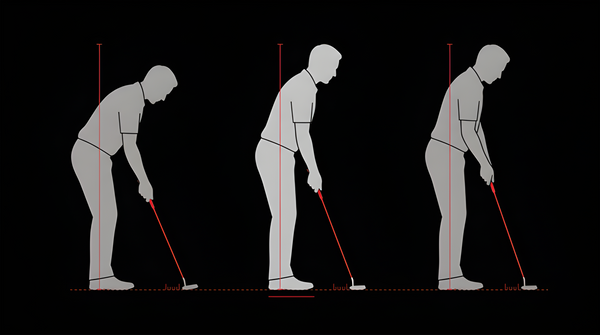
Weight interacts with length. A putter that is too long forces you to stand further from the ball and stand taller, raising your eye line off the target line. A putter that is too short cramps your posture and encourages pulled putts. Before finalising any arc-stroke putter decision, get your length measured correctly. The geometry of your stroke depends on it.
5. Loft
Standard putter loft runs between 2 and 4 degrees. This loft is designed for one specific hand position at impact. The position the designer assumed you would use.
Arc stroke players tend to have more variation in hand position at impact than SBST players. The curved hand path introduces small differences in where the hands sit at the moment of contact. Those differences change the effective loft. This matters. We will come back to it.
Top Putters for Arc Stroke Players (2026)
These are the most recommended putters for arc stroke players in 2026. Every one of them is a legitimate option. The list covers different price points, head shapes, and degrees of toe hang.
| Putter | Type | Toe Hang | Best Arc | Price |
|---|---|---|---|---|
| Scotty Cameron Newport 2 | Blade | Moderate-strong | Moderate to strong | $449 |
| PING Anser (PLD Milled) | Blade | Moderate | Slight to moderate | $449 |
| Odyssey Ai-ONE #1 | Blade | Moderate | Slight to moderate | $299 |
| TaylorMade Spider Tour | Mallet | Moderate (slant neck) | Slight arc | $349 |
| Cleveland HB SOFT 2 #1 | Blade | Moderate | Slight to moderate | $159 |
| Bettinardi Queen B 16 | Blade | Moderate-strong | Moderate | $450 |
Scotty Cameron Newport 2
The reference blade. 303 stainless steel, precision milled in California. Plumber's neck hosel with moderate to strong toe hang. The Newport shape has won more events on Tour than any other putter design. Customizable tungsten sole weights let you dial the swing weight to your tempo.
Strengths: Build quality. Resale value. Proven shape. Excellent feel on center strikes.
Limitations: Smaller sweet spot than mid-mallets. Off-center hits lose more energy. Premium price for a flat face.
PING PLD Milled Anser
The most copied putter design in history. CNC-milled 303 stainless. Plumber's neck. Moderate toe hang with classic offset. Tour-level milling and inspection process. PING's quality control is among the best in the industry.
Strengths: Consistent manufacturing. Timeless shape. Solid moderate toe hang for slight to moderate arcs.
Limitations: Less feedback than thinner blades. Face feel can seem muted to players coming from softer insert putters.
Odyssey Ai-ONE #1
Odyssey used artificial intelligence to design the face insert pattern, optimizing ball speed consistency across the hitting area. The Ai-ONE insert does a better job evening out speed on horizontal mishits than standard milling. Blade models (#1, #2) have plumber's necks with toe hang for arc strokes.
Strengths: Best value on this list. The AI insert improves horizontal forgiveness at a $299 price point.
Limitations: Insert feel divides opinion. Some players prefer milled stainless feedback. The forgiveness gain is horizontal only.
TaylorMade Spider Tour (slant neck)
The Spider is a mallet, but the slant neck configuration gives it moderate toe hang. This makes it one of the few mallets suited for a slight arc. High MOI from the large head. Alignment aids are prominent. Several PGA Tour players use Spider models with slant-neck hosels configured for arc strokes.
Strengths: High forgiveness and stability with arc-compatible toe hang. Good alignment features.
Limitations: Only suited for slight arcs. The large head can feel disconnected to players who prefer blade feedback. Face balanced in most configurations; the slant neck is a specific model.
Cleveland HB SOFT 2 #1
SOFT milling in 304 stainless. Plumber's neck. Moderate toe hang. At $159, it is the most accessible option on this list. If you are testing whether a blade with toe hang works for your arc before committing to a premium model, this is the place to start.
Strengths: Price. Soft feel. Solid build quality relative to cost.
Limitations: Lighter head than premium options. Less refined milling. You get what you pay for in sound and feedback.
Bettinardi Queen B 16
Royal Rose PVD finish. One-piece milled 303 stainless. Proprietary FlyMill face pattern for a firm, consistent feel. Plumber's neck with moderate to strong toe hang. Beautiful craftsmanship.
Strengths: Aesthetics. Milling quality. Firm, responsive feel at impact.
Limitations: Premium price. Limited availability. The firm feel is not for everyone.
Every putter on this list solves the toe hang problem. Every one matches an arc stroke. And every single one has a flat face with a fixed loft.
That matters more than you think.
The Factor Most Arc Stroke Guides Miss
Matching toe hang to your arc is the right first step. It gets the putter moving with your stroke instead of against it. But there is another variable that affects every arc stroke putter. One that almost no fitting guide mentions.
An arc stroke means your hands travel on a curved path through impact. That curved path introduces more variation in hand position at the moment of contact than a straight stroke does. Your hands are never in the exact same position twice. Under pressure, you press forward. On fast greens, you hang back. On the 17th hole with the match on the line, your hands do something slightly different than they did on the practice green.
Every shift in hand position changes the effective loft at impact.
The same stroke. The same putter. A few millimeters of hand variation. And two putts stop 3 feet apart.
Press your hands forward and you de-loft the face. The ball drives into the ground, hops, and the distance becomes unpredictable. Let your hands hang back and you add loft. The ball pops up, skids longer, and stops short of the target.
On a 20-foot putt, the same stroke can produce significant distance variation. Enough to turn a tap-in into a testy 3-footer. Not because you swung differently. Because your hands moved a few millimeters and the flat face could not compensate.
This is not a toe hang problem. It is not a head shape problem. It is a face problem. And it affects arc stroke players more than SBST players, because the curved hand path creates more positional variation at impact.
You matched your toe hang. You found the right head shape. Your stroke and your putter are finally working together on the horizontal axis. But on the vertical axis, every flat face responds the same way to hand variation: inconsistently.
Not sure which putter matches your arc?
Answer a few quick questions about your stroke and the miss that bugs you most. We'll match you to the putter built for your game.
Take the quizHow the Curved Face Changes the Game for Arc Strokes
A curved face is convex. The loft varies continuously from the bottom of the face to the top. There is no single fixed loft angle. Instead, the face provides a gradient: less loft at the bottom, more loft at the top.
When your hands press forward (a common tendency under pressure), you strike the ball higher on the face where there is more loft. The extra loft compensates for the de-lofting your hand position created. When your hands hang back, you strike lower on the face where there is less loft. The reduced loft compensates for the extra loft your hand position created.
The launch angle stays consistent. The ball speed stays consistent. The distance stays consistent.
For arc stroke players, this compensation is particularly valuable. The curved hand path amplifies hand position variation at impact. A curved face absorbs that variation instead of reflecting it back as inconsistent distance.
Three things happen simultaneously with a curved face:
- Loft adapts to hand position. Your hands shift. The face compensates. Launch stays consistent regardless of where your hands sit at impact.
- The ball contacts above the equator. The curved geometry ensures the ball is always struck just above the equator. Never at it. Never below. That produces immediate forward spin. Skid is reduced. The ball gets into true roll faster and holds its line better.
- The vertical sweet spot expands. From 1-2mm on a flat face to around 6mm (Quintic test), Same energy transfer whether you catch it perfectly or miss by a few millimeters vertically.
Consider the numbers: a 15-handicap golfer hits the sweet spot roughly 75 out of 100 putts. Even tour professionals miss it about 5 times in 100. A vertical sweet spot that is three to six times taller means more of those putts transfer the energy you intended.
For the arc stroke: the Z-Series
The myvicto Z-Series (Zeuzier) is built for the arc stroke. Its toe hang lets the face open and close with your natural rotation, so the head works with your arc instead of fighting it. That handles the direction. The curved face handles the part no flat face does: it adapts the loft to where your hands sit at impact, so your distance holds steady even when your strike height drifts. CNC-milled from 6061 aluminium in a Swiss workshop.

For strong arc players: the B-Series
The myvicto B-Series is a blade. Heel shaft. Full toe hang. CNC-milled from 6061 aluminium in a Swiss workshop. Traditional compact sightline for players whose stroke arcs 4 or more inches inside the line.
The curved face matters more for strong arc players than for anyone else. A strong arc means a longer curved hand path, which means more positional variation at impact. The B-Series absorbs that variation. Same 6mm vertical sweet spot. Same consistent energy transfer. The blade feel and toe hang your strong arc needs, with face technology that flat-face blades cannot offer.

For slight to moderate arc: the E-Series
The myvicto E-Series is a mallet. Flow neck hosel. Moderate toe hang. Higher MOI than a blade, which means more forgiveness on horizontal mishits. The shape suits the most common stroke type: the slight arc.
If you have a slight arc and want the stability of a mallet with a face that compensates for hand position variation, the E-Series covers both axes. Horizontal forgiveness from the head shape. Vertical forgiveness from the curved face. Same Swiss engineering. Same CNC-milled 6061 aluminium.

All three share the same curved face. The Z-Series is the toe-hang putter built for the arc stroke. The B-Series suits a strong arc that wants a blade. The E-Series suits a slight arc that wants a mallet's forgiveness. See how the curved face works.
Find Your Perfect Arc Stroke Putter
Two decisions determine whether your putter works with your arc stroke.
Decision one: toe hang and head shape. Match the degree of toe hang to the degree of your arc. Blade for strong arcs. Mid-mallet for slight arcs. This determines whether the putter moves with your stroke or against it.
Decision two: the face. A curved face compensates for the loft variation that your hands create at impact. A flat face does not. This determines whether your distance stays consistent when your hand position shifts. And it always shifts.
Most golfers get decision one right and never realize decision two exists.
Find Which Putter Fits Your Arc
Answer a few quick questions about your stroke and the miss that bugs you most. We'll match you to the putter built for your game.
Take the quizFrequently Asked Questions
What is an arc putting stroke?
An arc putting stroke follows a curved path: inside the target line on the backswing, square at impact, inside again on the follow-through. The putter face naturally opens going back and closes going through. The majority of golfers show some degree of arc in their stroke due to the lie angle of the putter shaft.
How much toe hang do I need?
It depends on the degree of your arc. Slight arc (1-2 inches inside the line): moderate toe hang, around 25-45 degrees. Strong arc (4+ inches inside): full toe hang, 45-90 degrees. Balance your putter on your finger. If the toe drops to the angle that matches your arc category, you are well matched.
Can I use a mallet putter with an arc stroke?
Yes, if the mallet has toe hang. A mallet with a slant neck, flow neck, or plumber's neck can work with a slight arc. Avoid face-balanced mallets with center shafts for arc strokes. The key is the hosel and balance, not the head shape alone.
What is the best putter for a slight arc?
A mid-mallet or flow-neck blade with moderate toe hang (25-45 degrees). The slight arc is the most common stroke in golf. Mid-mallets provide more forgiveness than blades while still allowing the natural opening and closing that a slight arc requires.
Does putter face technology affect arc strokes?
Yes. Arc strokes create more hand position variation at impact than straight strokes. That variation changes the effective loft on a flat face, producing inconsistent distances. A curved face compensates for this variation by adjusting loft based on strike height. The result is more consistent launch and distance.
How do I know if my putter matches my stroke?
Two tests. First: film your stroke from behind. If the head arcs inside the line and your putter is face-balanced, they do not match. Second: hit 10 putts from 20 feet with the same effort. If the distance spread is over 3 feet, the face may not be compensating for your hand variation at impact.
What loft should my putter have?
Standard putters have 2 to 4 degrees of fixed loft, designed for one hand position. The real question is whether the loft stays effective when your hand position changes. For arc players who tend to vary hand position more, a curved face that adapts loft to strike location provides more consistent launch than any single fixed loft angle.
Is a blade or mallet better for arc strokes?
Blade for strong arcs (full toe hang, compact head, free rotation). Mid-mallet for slight arcs (moderate toe hang, more forgiveness, enough rotation). Face-balanced mallets are not suited for arc strokes. The choice between blade and mid-mallet comes down to the degree of your arc and how much horizontal forgiveness you want. Read our full mallet vs blade comparison.
Related guides
- Mallet vs Blade Putter: How to Choose the Right One
- How to Choose a Putter: The Complete Guide
- Free Putter Fitting Experience
- How the Curved Face Works