What Is a Curved Face Putter? Vertical Forgiveness Explained
A curved face putter has a face that is rounded from bottom to top instead of flat, so its loft changes gradually across the face. It is built for vertical forgiveness: the launch (how the ball leaves the face) and the distance change less when your hands sit a little forward or back at impact.
If your putts finish short one time and long the next with what feels like the same stroke, this is the part of the putter that matters. This guide explains how a curved face works and what our tests show. It also compares it with a flat face and a stepped-loft face.
What is a curved face putter?
A curved face putter is a putter whose face is rounded from the sole to the top line, so its loft is different at each height of the face. Most putters have a flat face. If you hold a ruler against a flat face from the sole up to the top line, the ruler touches it along its whole height. On a curved face putter, the ruler touches in only one place, because the face bulges gently outward.
Because the face is curved, the loft is not the same everywhere on it. It changes gradually from the bottom of the face to the top. We checked this with Quintic Ball Roll, a camera system that measures how the ball leaves the putter. With the shaft held vertical, the launch angle changed with the point where the ball met the face.
Curved putter faces are not new. Rolled-face putters were already on sale in the 1990s. The idea was sound. The execution was not there yet. Today, CNC milling can cut the curve precisely, and launch monitors can check what it does to the ball.
Where does the ball meet a curved face?
A golf ball is a sphere. Whatever the shape of the face, the ball touches it at a single point, and the push of that contact goes through the center of the ball. So the contact itself does not spin the ball. Any spin comes from friction while the ball slides against the face.
The height of that contact point on the ball depends on the loft at impact. With zero loft, the face meets the ball at its equator, the line around its middle. With positive loft, the face meets the ball slightly below it.
On the myvicto face, the ball is struck at the equator. It leaves the face with a flatter launch: barely lifted into the air and not pushed into the grass. That kind of start helps keep the slide shorter.
What does vertical forgiveness mean in putting?
Vertical forgiveness in putting is how little your putt changes when something small goes wrong. The ball meets the face a little higher or lower than you meant. Or your hands sit a little forward or back at impact.
When putter reviews talk about forgiveness, they usually mean something else: how much the head twists when you miss toward the heel or the toe. That is horizontal forgiveness. Heavy weight placed at the edges of the head (a high MOI) handles it well, and most modern mallets are built around it (see mallet vs. blade putters).
Vertical forgiveness covers two things that happen up and down. The first is strike height, meaning where the ball meets the face between the sole and the top line. The second is the loft of the face at impact, which depends mostly on where your hands are when you strike the ball.
Both change how the ball leaves the face, and the result shows up as distance. Two putts hit at the same speed can still stop at different distances if one launches higher and slides longer before it starts rolling.
This matters because putting is a big part of the score. Dave Pelz puts it at 43 percent of the strokes in a round.

What happens with a flat face?
Most putters are built with between 2 and 5 degrees of loft, according to golf engineer Dave Tutelman. The job of that loft is to lift the ball out of the small dip it sits in on the green and get it moving.
With too much loft, the ball bounces and skids longer than it needs to. Skid is the slide before the ball starts rolling. With too little loft, the ball is pushed into the grass and can bounce as well.
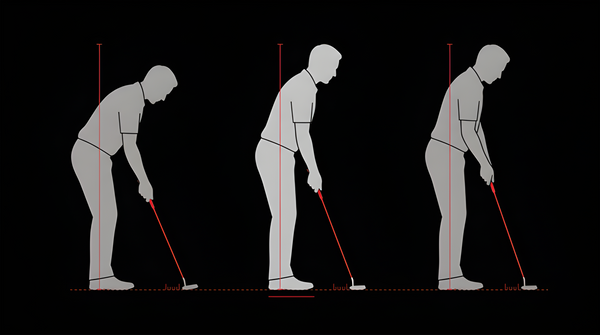
On a flat face, the loft you get at impact follows your hands. Tutelman puts it simply: a forward press (pushing your hands toward the target before or during the stroke) takes loft off the face. Leaning the shaft back does the opposite.
Because the face is flat, the change is one for one. Two degrees more forward lean means two degrees less loft, whatever part of the face you hit. Our guide to how putter loft works goes further.
Strike height works differently on a flat face. The loft does not change when you strike higher or lower, because the face has the same angle everywhere. What changes is how solidly the ball is struck: a strike above or below the center of the putter head usually sends the ball off a little slower.
So when the distance varies from one putt to the next, it is not always you. Part of it can come from the face.
How does a curved face change the loft at impact?
This is the main idea behind the curved face. We call it Loft Compensation.
- Hands forward: the face tilts forward and loses loft. The ball meets a part of the curve with more loft.
- Hands back: the face gains loft. The ball meets a part of the curve with less loft.
The loft at impact changes much less than on a flat face. Your launch stays more consistent from putt to putt.
Our Quintic Ball Roll test held the shaft vertical, to isolate the face itself. It measured how the launch changes across the face. It did not include shaft lean, and it did not test a flat face next to ours.
Find the right putter for your stroke
Answer a few quick questions about your stroke and the miss that bugs you most. We'll match you to the putter built for your game.
Take the 2-minute quizThere is also a trade-off. On a curved face, strike height does change the launch, because the loft is different at each point of the curve. That is why the useful zone on the face is a window with a limited height, not the whole face.
How big is the vertical sweet spot on a curved face putter?
In our Quintic test, the vertical sweet spot of the myvicto face is about 6 millimeters tall. That window is your margin for error when the strike or your hands move a little. On a flat face, the usual estimate is 1 to 2 millimeters.
The 1- to 2-millimeter figure for a flat face is a theoretical estimate, not a measurement. No flat face was tested next to ours.
The two numbers also do not measure the same thing. Our 6 millimeters is the height where our face gives a flat or slightly rising launch. On a flat face, the launch does not change with strike height, so its 1- to 2-millimeter figure is about striking close enough to the center for solid contact. Read them as two different measures, not as a head-to-head result.
Does a curved face putter reduce skid?
Every putt skids first. Right after impact, the ball slides across the grass before it starts rolling. Cure Putters puts the skid at 10 to 20 percent of the putt's length, and physicist A. R. Penner, citing earlier studies, puts it at about 20 percent.
No putter makes the ball roll from the first inch, curved or flat. According to Cure Putters, a ball needs a little over 700 rpm of spin to roll right away, while a putter face gives it about 50 to 100 rpm. The friction of the green does the rest. What the face can change is how the ball starts, which then decides how long the slide lasts.
Our own data adds one result. In our Quintic Ball Roll test, the ball skidded about 20 to 30% less when it was struck higher on our curved face than when it was struck low on it. The slide was also much more consistent from one putt to the next.
What our test shows, and what it doesn't
- It shows that the launch changes with strike height on our face, with the shaft held vertical.
- It shows less skid, and more consistent skid, on higher strikes than on low strikes on the same curved face.
- The size of the skid difference depends on which low strike height we used as the starting point.
- It shows that on our face, skid depends on strike height. That is the trade-off described above.
- It did not include shaft lean. Loft Compensation is how the face is designed to work, and it was not measured with the shaft leaned forward or back.
- It did not test a flat-face putter or another brand next to ours, so it is not a "less skid than a flat face" result.
- It covered three of our series: the B-Series, E-Series and L-Series.
Is a curved face the same as a stepped-loft face?
No. Another way to change loft across the face is to build it in steps. The best-known example is Descending Loft Technology (DLT), created by SIK Golf. The PGA Tour described it in June 2021. The DLT face has four flat surfaces. Loft goes from 4 degrees at the top to 1 degree at the bottom, one degree per step. Its stated purpose is to deliver the right loft at impact when shaft lean changes.
In January 2025, MyGolfSpy reported that Cobra uses a DLT face on some of its putters.
Same problem, different geometry: DLT uses four flat steps, the myvicto face one continuous curve.
Having four flat zones also means three edges where the loft changes by one degree at once. A curve changes gradually, with no edge. We are not claiming that one design works better than the other. We do not know of any test that has measured the two side by side.
Flat, stepped and curved faces side by side
| Flat face | Stepped-loft face (DLT) | Curved face (myvicto) | |
|---|---|---|---|
| Loft across the face | The same everywhere, usually 2 to 5 degrees | Four flat zones: 4 degrees at the top down to 1 degree at the bottom | Changes gradually from bottom to top, with no steps |
| What shaft lean does | Changes loft one for one | Changes loft, and can move contact to another zone | Moves contact along the curve, to a part that offsets the change (Loft Compensation) |
| What strike height does | Loft stays the same; off-center strikes usually lose some ball speed | Loft jumps by one degree at each zone edge | Launch changes with strike height (our test, shaft vertical) |
| Vertical sweet spot | About 1 to 2 mm for solid contact (theoretical estimate, not measured) | No figure published that we know of | About 6 mm launch window (our Quintic test) |
| Source | Tutelman, Design Notes: Putters | PGA Tour (June 2021); MyGolfSpy (January 2025) | Our Quintic Ball Roll test |
Who is a curved face putter for?
A curved face putter makes the most sense if your distance varies more than you would like, even when the stroke feels the same. It is also worth a look if your hands sit a little farther forward on some days than on others, which is common and hard to notice without a camera.
It is not a replacement for practicing speed. And if you already strike the same spot every time with a steady shaft, a well-fitted flat face may suit you just as well. The simplest way to decide is to putt with one on your own greens. Every myvicto putter comes with a 30-day Perfect Fit Guarantee: if it does not suit your stroke, you send it back.
Which myvicto fits your stroke?
Tell us how you putt and where your misses go. We'll match you to a model in about two minutes.
Take the quizWant to see how the face is built? The technology page shows the curve and our Quintic analysis.
Keep reading
Frequently asked questions
Does a curved face putter stop the ball from skidding?
No, every putt skids for a short distance before it rolls. In our Quintic Ball Roll test, the ball skidded about 20 to 30% less when it was struck higher on our curved face than when it was struck low on it.
How much loft does a curved face putter have?
It depends on where the ball meets the face, because the loft changes gradually from the bottom of the face to the top. That is why the launch changes with the strike point.
Is a curved face putter the same as a stepped-loft putter?
No. A stepped-loft face such as DLT has four flat zones, each with its own loft, while a curved face changes loft gradually along one continuous curve.
What is the vertical sweet spot of a putter?
It is the height of the zone on the face where a strike still gives a good result: about 6 millimeters on the myvicto curved face in our Quintic test. The usual estimate for a flat face is 1 to 2 millimeters, but the two figures do not measure the same thing: ours is a launch window; the flat-face figure is about solid contact.
Does strike height matter on a curved face putter?
Yes, because the loft is different at each point of the curve. The design makes the loft at impact depend less on your hands, and the sweet spot is a window with a limited height.
Who should try a curved face putter?
Golfers whose distance varies from putt to putt even when the stroke feels the same, and golfers whose hand position changes from day to day. If you already strike the same spot with a steady shaft, a well-fitted flat face may suit you just as well.
Sources
- Dave Tutelman, Design Notes: Putters (putter loft range, effect of forward press on loft).
- Cure Putters, Skid, Roll, Launch and Loft Myths (skid length, the 50 to 100 rpm a putter face can give, the just over 700 rpm needed for pure roll).
- A. R. Penner, The physics of putting, Canadian Journal of Physics 80 (2002) (a putted ball reaches pure rolling after about 20 percent of the putt, citing earlier studies).
- Dave Pelz, Dave Pelz's Putting Bible (share of strokes that are putts, 43 percent).
- PGA Tour, What is SIK Golf's Descending Loft Technology (June 17, 2021; DLT face lofts, 4 degrees at the top to 1 at the bottom).
- MyGolfSpy, How Much Technology Can COBRA Golf Stuff Into A Putter? (January 21, 2025; Cobra putters with a DLT face).
- MyGolfSpy, History's Mysteries: The Strange Story of TearDrop Putters (July 25, 2024; rolled-face putters sold in the 1990s).
- myvicto, Quintic Ball Roll test on our B-Series, E-Series and L-Series putters, shaft held vertical. Recorded on a Quintic Ball Roll system. This is our own test, not a study published by Quintic.